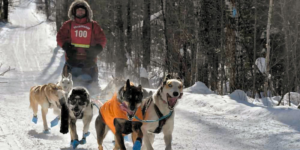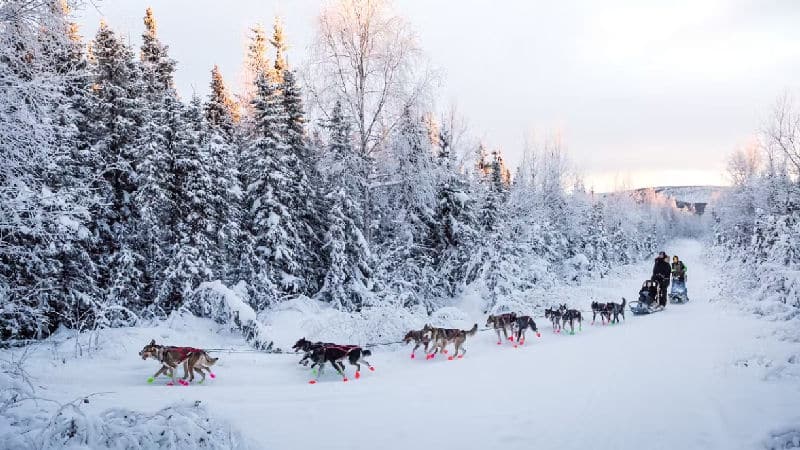

Jeff Deeter ran his first Iditarod in 2008 at the age of 19.
He finished in 59th place, with a happy, healthy team of dogs.
In the summer of 2010 Jeff met his now-wife, KattiJo. They were co-workers at a dog mushing tour company in southeast Alaska.
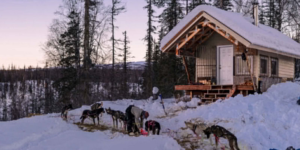
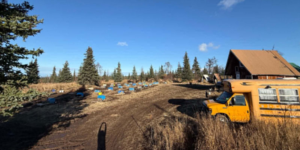
In 2013 Jeff and KattiJo purchased a piece of land, started their own dog tour company, and began construction on their home.
Jeff ran the Iditarod again in 2018, and has run it each year since. His highest finish was 12th place in 2021.
Your kennel name, Black Spruce, is quite unusual. Where did it come from ?
As my wife and I were starting our kennel, we wanted a name that reflected our surroundings, and was going to be a guarantee for all of our kennel visitors.
As we are surrounded by black spruce in Fairbanks, nothing could be more appropriate. And, when it comes to racing, the spruce really know how to burn!
Your website is outstanding. Who designed it and your logo too ?
My talented wife, KattiJo, has really been the driving force behind all of our business development and marketing.
She has a great eye, and developed our website and maintains all of our online media.
The internet is really key in the success of our tour business, and social media has been critical for attracting fans and retaining sponsors.
On an average day out on the trail, how much time is spent running the dogs ?
From mid-October to the end of March, we are typically on the trail for a minimum of six hours a day.
Our longest trips of the season will typically cover a few hundred miles in the backcountry north of our home, and will last for two to three days.
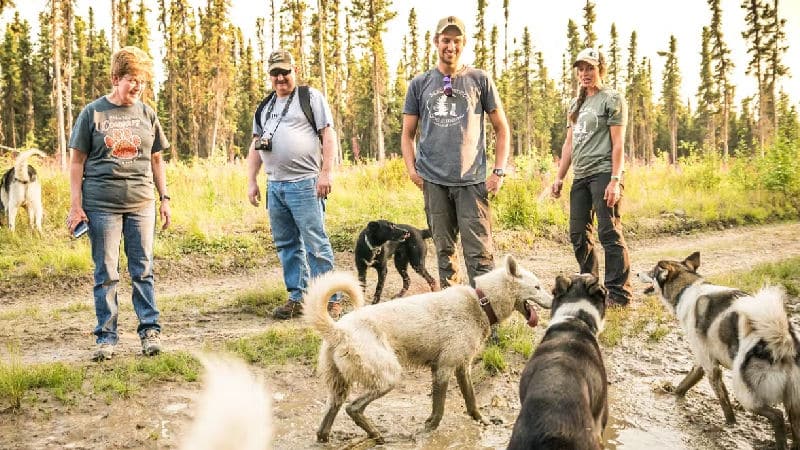
Do you think the relationship between a musher and his dogs is stronger than the relationship between a pet dog owner, and their dogs ?
Oh, absolutely! The bond that we have with our sled dogs is tighter than that of 99% of pet owners and their pets.
The biggest reason for this is the amount of time that we are able to spend with our animals.
Your typical pet owner has at most, 30 minutes in the morning before going to work, and at most, 2 hours in the evening after returning from work. And this is only if they prioritise their pet and give them full attention.
As a musher, my dogs are my sole focus year round, and from September to April, every day of the week is structured around them and their needs.
It is the only way to be successful, and the reason for our tight bond.
Well, that and raising them from birth.
This also plays a key role in that bond.
What’s the maximum number of miles a sled dog team can travel in one day ?
The most I have ever run in a 24 hour period has been 210 miles.
This was under perfect trail conditions, with a peak trained team, in perfect health.
Our average in racing is more like 120-140 miles in 24 hours, 50-70 miles per run.
My longest single run has been 105 miles. Again, perfect trail and peak performance.
When training for a race, how do you decide to up the number of miles that you train ?
There are numerous factors that go into our training schedule, and miles that we run.
As a rough outline, we essentially follow an ultra marathoners training regime; upping the miles every 7-10 days for three weeks, and then taking the fourth, “by-week,” to relax a little and reduce our distance before another series of mileage increases.
That being said, it all has to do with the dogs in front of me, and how they are feeling.
Weather is also a huge factor in our area.
My best laid plans very rarely come to fruition in Interior Alaska, haha.
A lot of our training is very much based on wind and drifting, and sometimes a 7 hour run only covers 40 miles, if the trail conditions are tough.
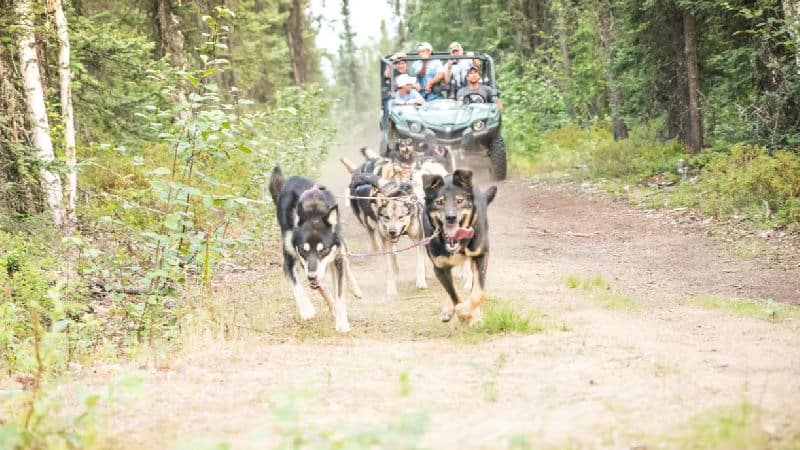
There are rookie mushers, veteran mushers, and legendary mushers. If I was to ask you if one musher stands out to you, who would that be and why ?
In my mind, no one will ever make an impression on me the way that Lance Mackey did.
A part of this could be the timing of his mushing success.
I was a teenager and just getting started in the sport as he won his first Yukon Quest.
Watching the way that he ran dogs, and the drive and determination that he put forward to essentially “pull himself up by his bootstraps” was quite motivational for a young musher.
But, Lance also had this energy and drive that you rarely see in humans.
He embodied what it meant to be a musher at that time in my life, and I was in awe of his team.
As time has passed, and I have travelled with different members of the sport, I have developed feelings and opinions about most mushers.
I respect and admire a lot of my fellow competitors for a variety of different reasons.
Dallas Seavey is certainly one of the most calculated individuals I have ever seen in the sport of dog mushing.
I honestly don’t think that he makes mistakes while on the race trail!
Brent Sass is a friend of mine, and an incredible outdoorsman.
How he manages to live his remote life and keep all the balls in the air is beyond me, but it takes some serious drive and determination, and a lot of willpower.
He is always smiling, and always makes it out of whatever jamb he gets himself into.
His dogs are also something incredible to witness on the trail!
Jessie Royer has had an amazing career, and has been a lot of fun to get to know a little over the last few years.
She has such a positive attitude, and is always up for a conversation and ready to share her wealth of knowledge.
She always manages to have a happy and healthy group of dogs in her team, and has had some very high finishes with a large number of dogs.
The Iditarod celebrated its 50th year in 2022, and it also saw your wife, KattiJo in her rookie Iditarod race. How did you feel about her being out on the trail in the toughest race on earth ?
KattiJo has been my kennel partner for years now.
Over the last few seasons, she has done all of the training with me and been a key reason for my success in Iditarod.
I have never had concerns about her ability level, and don’t usually worry about her on the trail. My fear is how I will do without being able to reach out to her during my race, haha.
Obviously, 2022 did not go as planned.
However, Katti is headed back in 2023 with our best team members, and will be shooting to have a successful run all the way to the finish.
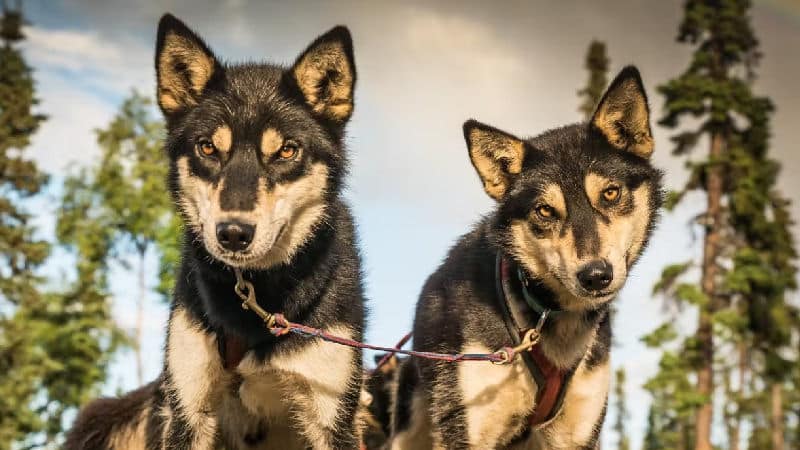
It is important for your dogs to be kept healthy when preparing for such a long race. How do you keep your dogs healthy ?
Diet is really key.
A team’s health starts with their food.
We feed Inukshuk kibble, and supplement with a wide variety of raw meats during the training season.
We also have a few key supplements that we feed and really believe in. Dr. Carson’s Pet Food Supplements manufactures a bee-pollen/flax base powder called Pro-Dog Complete.
This has really helped with GI health and strengthened our dogs immune system.
We feed this in conjunction with Dr. Carson’s Pre-Probiotic, which has millions of active live microbes, and helps keep the GI flora healthy and in balance when your dog is performing under high stress conditions.
We also have a few trail supplements that we feed during racing, specifically targeting red blood cell replacement and muscle rejuvenation.
When it comes to running, the frequency and distance are key factors for our dogs physical health.
We want to build a strong and well rounded team, but there is such a thing as “over doing it.”
Our rest days and “by weeks” are really critical, especially with the added work load of running tours all winter.
Our race team is still a working team, at least two days each week, and the physical nature of our tours is something we consider when building our training schedule.
We will often train on the same days that we tour, but the intensity of that run is not usually as high as on their non-touring days.
What do the vets look for when checking the dogs before a race, at each checkpoint and the end of the race ?
While the vet team is focused on all parts of the sled dog, from nose to tail, I have them specifically target the areas that I can not identify and treat as easily on the trail.
This means specifically, the heart, lungs and hydration.
As I arrive into a checkpoint, I usually discuss specific issues with the vet team, and have them assess those dogs first.
If everyone has a good appetite and smooth gait, I want them to still listen to heart and lungs, and give them a secondary check for good hydration (this is in addition to my own skin and gum check).
I try to be respectful of the vets time and not have them waste energy doing a full exam of a dog that I know to be in good physical health.
Do you carry any medical equipment to use on your dogs in case they are injured ?
I have a full vet bag that I carry on every run, all year.
This includes my basic ointments and liniments, but also flex wrap, compression wraps, and shoulder vests.
In training, I also carry antibiotics, pain killers, anti-diarrheal, nail trimmers, stapler and a few other miscellaneous items (remembering that I can be away from the kennel for a couple of days on our longer trips).
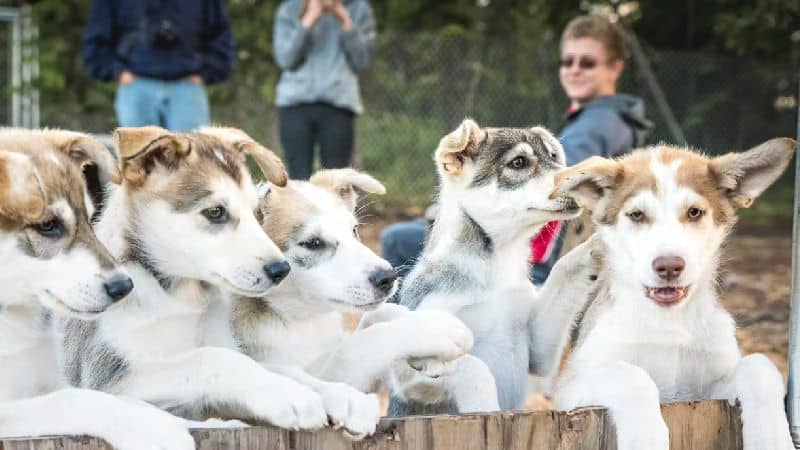
How many dogs do you presently have in your kennel ?
We have a total of 50, with the addition of 7 new puppies from Brent’s female, Marble.
What’s the largest amount of dogs you’ve had in your kennel at any one time ?
55
During a race what kind of things do you eat and drink ?
I am a huge fan of eating and drinking while on the move with my team, and will literally risk frostbite for a mouthful of snack.
Hydration is key for staying warm in the cold, and I drink a lot of clear, warm water.
I also need coffee to survive, and that is never far from my reach.
My snacks include a lot of my favourite nuts (cashews, in particular), beef jerky, dried fruit, chocolate, my Mom’s homemade cookies, and Pringles.
In general, I don’t have a craving for processed food while on the trail, and have no interest in refined sugars.
Once you get home after taking part in a long race, how long do you rest your team before going out on the trails again ?
Recovery time will really depend on the race, and our health during that race.
The last few times that I have finished Iditarod, my dogs have been ready to go the very next day.
That being said, I am usually not.
So, I typically take a week off before jumping back on the runners for any serious mushing.
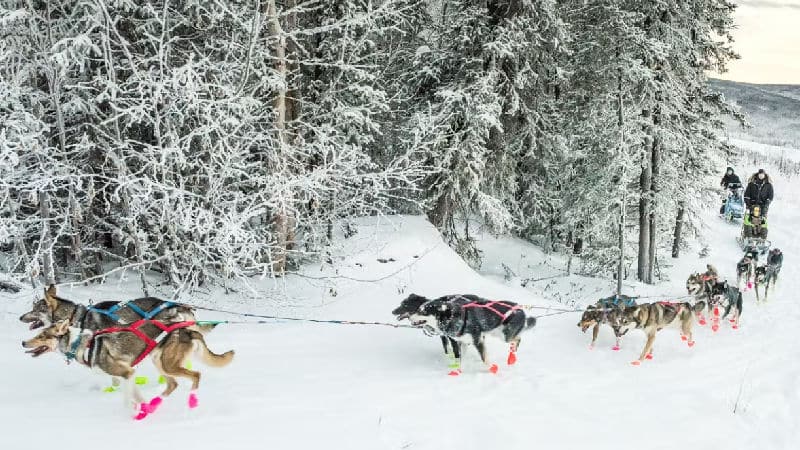
A lot of people run their dogs just for fun, so their dogs get some exercise. How did you decide you wanted to compete professionally as a dog musher ?
I saw my first dog race at the age of six.
I was captivated and knew that mushing was something for me.
I am naturally a competitive person, and the idea of challenging myself and my dogs has always seemed like a good fit.
I started working for a couple that was involved in the Iditarod, and helping them with their team got me hooked on the idea of racing.
After my first race, and forgetting my gangline, getting lost and placing almost last, I knew that I could improve. And, that is still what I am doing today- trying to improve.
Tell us about your journey from deciding you would like to be a musher and getting your first dog to building a team. How many years did it take to build your team ?
Because I worked for a family of mushers with a large kennel, it took me almost no time to acquire a team.
My first leaders were Buck and Darrell, and I thought those two were just the best dogs a musher could have!
They were very disciplined, focused and well mannered, and were something like 12 when they came to me.
Awesome first dogs!
By my second year in mushing, I had a group of 12 dogs that stayed within the kennel that I worked for.
Eventually, my mentors retired, and I took over their dogs and operation.
I was 18.
Preparing for a race is a huge task in itself. Food bags have to be prepared, as well as a lot of other things. But it’s not just the mushers that have to prepare for the race. There are people that break the trails, put in the trail markers etc. How important are these “behind the scenes” people, who are mostly volunteers ?
Volunteers are the only reason that we have our races!
As mushers, we often forget how many moving parts go on behind the scenes of a single race.
There are pilots, vets, checkpoint staff, time keepers, medical personnel…
Everyone just giving their time so we can all do what we love.
I am very grateful that people care so much about the sport and are willing to give their time in this way.
It is a wonderful community!
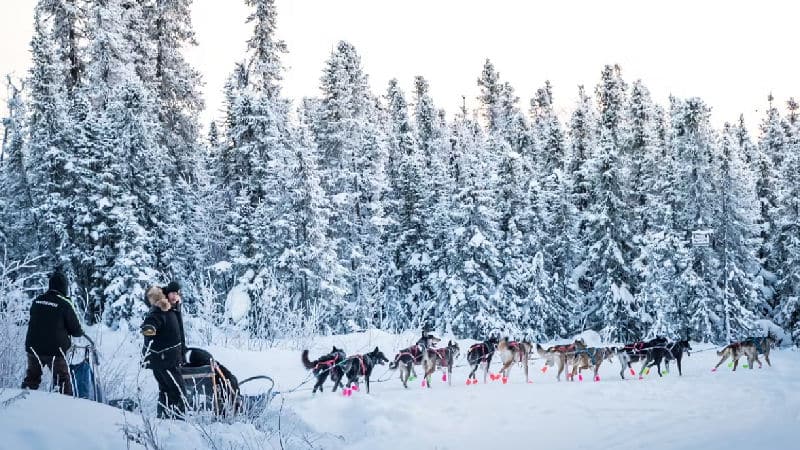
What do you hope to achieve within the next five years in your mushing career ?
I have never been a musher that is determined to win every race that they enter (or any race, for that matter).
However, my goal is always to be more competitive with each race.
When it comes to Iditarod, I have been able to achieve this goal, and only continue to place higher.
For 2023, I am taking a year away from Iditarod to focus on a couple of the remote races that I have wanted to do for years: the Kobuk 440 and the Kuskokwim 300.
These both have a competitive field each year, and offer a good purse (fun incentive!).
I will not be shooting to win either of these races, obviously, but I do hope to be competitive, and run my best race possible.
A huge thank you to Jeff Deeter for taking the time to answer these questions.
We wish him the best for his future race career.
If you want to find out more information about Jeff, KattiJo and their dogs their website is BlackSpruceSledding.com