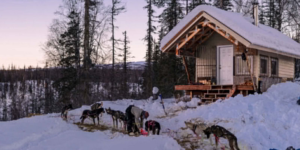
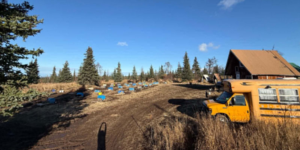
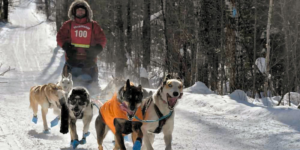
Pam Redington lives in Manley Hot Springs, Alaska.
She was married to Joee Redington Jr, the eldest son of Joe Redington Snr, who was the “Father of the Iditarod”.
Together Pam and Joee were renowned in the state of Alaska for their sprint racing kennel – Iditarod Kennels.
Joee ran the Iditarod, along with his father and brother, Raymie, gaining his best place of third in 1975.
Although Joee’s dad was the founder of the Iditarod, Joee preferred the shorter sprint races.
Sadly, Joee passed away in 2017 from complications for gall bladder surgery.
Faye had the opportunity to speak to Pam on the phone about her life in Alaska and her role being married to one of the best known sprint mushers in the world.
How do you pronounce your husbands name ? Is it Joe ? Joey ?
His given name is Joe. But my husband was always called Joee to separate him from his dad.
When you met your husband, was he already mushing ? Were you as smitten with dogs as he was ?
My husband came to Alaska when he was five in 1948. And they picked up a dog then and he has been mushing probably, since he was six or seven. He raced as a junior, which is, you know, you could start at five or six, and up until you were 18. So when he turned 18, in the summer of 61, after that he was eligible to race with the adults. And that’s when his official career started was in 62.
So he’s been racing more or less all his life, that’s amazing.
Yes, and from about 1932, or 1933, until 1973, there were no long distance dog races, it was all sprint racing, which is anywhere from probably eight to 10 miles up to about 30 miles. And that was the mileage that they had. And at the time, he started in 61, there was one class.
So if you were a beginner, or a pro, you raced against each other. it was called the unlimited class, which means there was no limit to the number of dogs you could have in your team. As long as that you started with at least seven and finished with five
That’s really interesting. I didn’t know any of that.
I’ll give you some more history because he’s more involved with the other kind of history, it’ll help you. In the late 60s, maybe about 69, they decided to have two classes of sprint dogs races. One was a seven dog class, and one was the Unlimited, and the seven dog class did not have any money. So that was for beginners and people to learn how to race. And then in the 80s, probably the latter part of the 80s, they decided to expand the limited class. And they opened it up to four dogs, six dog and eight dog classes. So you could race the four dog class or the six dog or the eight dog or two or three classes if you had enough dogs and wanted to do it that way. And then a purse was then put on the limited class. But Joee always ran Unlimited, and that was what his passion was for.
That’s brilliant. Thank you for that.
So did Joee want to follow in his father’s footsteps regarding racing in the Iditarod ?
In a way when the race first came out in 73, he looked at the people who were running in it and a lot of those people were former sprint mushers who were not in the top end of their profession and in the competition, and there was a lot of publicity and stuff and he decided that, you know, if they could do it, he could do it. He wanted to test himself. So the first Iditarod was 73 and he helped at the start and we boarded mushers. We were married by that time and we boarded mushers and lived in Knik. And then in 74. He wanted to try it so he gathered up a group of dogs. And he had two separate teams. He had his sprint team and he had an Iditarod team and he trained his sprint team in the daytime his Iditarod team at night. And then in 74, Raymie, Joee and Joe senior all finished 7th, 9th and 11th respectively. And then in 75, Joee went back and raced it again. And he finished third an hour and 28 minutes behind the winner, who was Emmett Peters. And after that, he said, there’s only one distance race. I can race every single weekend in the sprint class from November from Thanksgiving, end of November until the beginning of April. I can race a race every weekend. So he sold all of the Iditarod dogs that he had, some to his dad, some to Rick Swenson, some to Dick Mackey. And he went back to his real passion of sprint racing.
That’s really interesting. I honestly didn’t know any of this.
What did dog mushing mean to Joee ? It obviously meant a lot to him for him to want to do it every single weekend.
Yeah, it was a passion. It was an addiction. We always called it an addiction. You couldn’t get out of dogs. You always were thinking about dogs, getting better, making the dogs better, doing better nutrition, breeding, everything. That was his whole passion and life.
I like how you just explained that its an addiction. That just sums it up totally.
What did the Iditarod mean to Joee ?
It was a challenge. And it was something he did. And when he finished third, he said, you know, I can do it. If I wanted to continue, I could, but he did not want to, he wanted to do sprint mushing, it was something he liked much better.
He was always interested in it. We followed it religiously, every single year. And he always had people that he knew and talked with and stuff in it. So it was a passion, but not for him to participate.
So even though he didn’t participate annually, he still was very interested in it that he kept up with it yearly. Just still had a part in it by watching it following it. I believe Joee was a great mentor to many mushers. He helped them out and told them his secrets regarding training, who were the mushers he took under his wing and what secrets did he share?
I don’t think there were any secrets. They had lots and lots of discussion. There used to be crowds of mushers who would come to visit and they’d sit up at night after training and feeding and be talking until one or two in the morning, and they discussed everything and shared ideas and things that work. There are no secrets. There’s no one path to success, everybody has their own path. And he discussed a lot, you know, over a 50 year career with lots of people. And you know, some of them were Iditarodders, and some of them were sprint. He liked talking dogs and seeing what other people, what their ideas, what their breeds, what their nutrition, their different things, the way they train.
So rather than secrets, it was more of a way that mushers interacted with each other and talked and learnt stuff from each other.
Yes.
Did he have a favorite dog ?
Well over 50 some years, you don’t have one favorite, you have a favorite at different timeframes.
The latest one that he was totally devoted to, was a dog named Ty. And he was born in 97. And he was in the race team for seven or eight years. And then we bred him and he passed away. Prior to that he had a dog named Banjo in the 90s. That was a leader. That definitely was one of his favorites. One called Ripple from the seventies. In 74, that dog led his team to just before he got to Rohn, no, he led out of Rohn. And he ended up having to haul it for aways into McGrath. Because he broke his leg. And then Joee sent him back to me. But he said that was the toughest dog he’d ever seen, because he even kept going with a broken leg for a while.
That’s such a great story. Thank you for sharing that with me.
Over the years how many different teams did Joee race. And was there one specific team that meant the most to him?
You couldn’t say one specific team, because over the years, you would have a core group of dogs living with all kinds of dogs moving in and out of it. And then as your core group aged or whatever, you replace dogs, so over 50 years, he probably had a different team every other year, and even every year, there wouldn’t be the same group.
So that’s a lot of dogs throughout his lifetime, then ?
Very much so.
Can you tell us about the Manley Hot Springs Golden Clipboard Award and what it meant to Joee ?
It meant a lot. We had the Iditarod come through Manley three different times 2003 2015 and 2017. And he got the award in 17. And he passed away in August of 17. He designed the layout of the checkpoint. He organized it all three times he organized it laid it out, did a lot of the work. The last year at 17. He didn’t do as much work, you know, because he couldn’t. But the checkpoint was the group effort of a lot of people. It wasn’t just one person. It was the whole community worked for that. And it meant a lot.
Can you put into words the passion Joee shared for mushing as well as the love he had for his dogs ?
I have no idea how to do that. He called it an obsession, an addiction and a passion. And that was what his whole life was about.
I can totally relate to that. I really can.
How many races did Joee compete in through out his life and which do you think meant the most to him ?

Well over a 50 year career he raced hundreds of times literally, he had a number of trophies for lots of different things. He won the Fur Rendezvous in Anchorage in 1966. And that was one thing that he really was proud of. He was second place in the North American championship in Fairbanks more than once, and he mentored a guy named Michi Konno, who has run the Iditarod in the last couple of years. And Michi came from Japan, the biggest team he had run with was a six dog team. He leased our team for the North American. He did it twice. The first time, I believe, he was sixth or eighth. And the second time he won the North American with our team. And Joee was very, very proud of that.
Sounds like he had such a great life, not just great moments in his life. I mean, all these stories, you’re telling me I’m just smiling all the way through. It just sounds absolutely fantastic.
Do you have a specific memory of Joee crossing the finish line of the Iditarod? How did you feel ?
Well, I told him both times he ran, well actually in 74, I told him I wasn’t coming to the finish line. We had young kids and I had a yard full of dogs. So I told him I wasn’t coming. But in 75, both Violet, Joe seniors wife, and I told our guys, we weren’t coming unless you were going to win. And it got down to the point where both of us had to go because there was a chance, a very, very good chance that the two of them would be the winner. Joee finished third and his dad finished fifth.
So did you end up going then?
Yep, thats the only time I went. I did see him come over the finish line at about one thirty or two in the morning, something like that. grandpa came in at around five o’clock. And at that time, the Nome hotel, the Nugget hotel there, the kitchen closed at eight o’clock. So they came in and they were hungry. But there was no way. You couldn’t get any food for them. And so Terry Atkins, who was the vet that year, went into the kitchen, found a coffee maker and scrambled a couple eggs for them when they came in.
Oh, wow. That’s brilliant.
What would you say was Joee’s all time proudest accomplishment?
Its difficult. His goal was to win the big sprint races and winning the rendezvous and coming in second more than once in the North American I would say was probably some of the proudest accomplishments that proved his team and himself.
I am sure Joee had many great stories about being out on the trail. Could you please share a few with us?
Well, the one that I recall the most was Raymie, Joee, Joe senior, Dick Mackey, Jerry Riley. And I think one other person on the 74 Iditarod they were going through ptarmigan pass at that particular year, not Raney Pass. They went through ptarmigan. And a storm came up and it was really windy. And so they carved out a snow cave. And they all sat there for quite a while and he said Raymie was sitting there in his bunny boots, tapping his feet together saying his feet were freezing. So he kept tapping them together. And finally the storm died out and they all went out hook their teams together in a line and headed off over the pass. And Jerry Riley was in the lead. And he kept saying I think we go up that Canyon there. I think we go there and they’d get there. No, that wouldn’t be right and they would keep going. But they finally made it to Rohn with changing the lead team many times.
Did Joee always use the same kind of sled every year ? Did he have many different sleds ?
Joee had many, many, many different sleds. He had one sled that he used in the Iditarod that he and Dave Olson built at night for the 74 I think he used it again in 75 but that was his Iditarod sled. But over the years in sprint mushing he had many sleds by many very accomplished builders. And when he passed away, I had a large sale a year later, and we had 15 sleds in the yard.
What was Joee’s ultimate dream?
To be first in every single race he ran.
That’s a good dream to have. Goals !
Did you ever go out on the sled with Joee, do you have a memory you can share with us regarding this?
I wouldn’t say I have a magical memory but I went out with him every day. All fall we did. I rode in the sled for a long time before we had four wheelers. And after we did four wheelers, and started using them I was the pilot car and I ran ahead of him all the time. And then after a while I rode, depending on how the training went, and then different things. I would ride on the four wheeler with him and then if we had a tangle or something I jumped off and took care of it but I rode with him every year many, many, many times and we double sledded a lot.
Did you enjoy going out on the sled?
Oh, yeah, I like seeing the back end of dogs I would pick up on some stuff and he would point out different things. And after a little while, like, I would catch on to a lot of this stuff, and we’d see the same things, and then talk about it.
So you were his extra pair of eyes really then?
Yes. We had at many times, over the years we had anywhere from 60 to 166 dogs. So I trained all puppies and half of the yearlings and he would train half of the yearlings and the team and then we often had a handler to help. But I trained all the puppies for the first year, so I knew the dogs
That’s amazing.
Out of a 24 hour day, how much time did he put into his dogs, feeding them, training them, etc. ?
I would say 16 to 18 hours because he would go out after supper and drag trail and do things on the trail to make the trail good enough. In sprint mushing, you have to be able to average 20 miles an hour for 20 miles to be competitive. So you have to have a trail that you can go 20 miles an hour on. So there was a lot of trail work involved.
So what was Joee’s training regime like?
Well, we would usually start on the first of October on a four wheeler or double sledding or some such like that. And we start at four miles, and you’d go ten days at four miles and you go six miles, and we would up it in increments of two until they work twelve miles and then we steadied them at that, then went to fourteen, sixteen and he was going twenty miles by Christmas. He make a couple twenty mile runs. But sixteen miles was the usual for the sprint mushing team. When he was training Iditarod, and this was in 74, 75. So it was a whole different ballgame, then he ran a lot of twenty fives and thirties.
Okay, that’s a lot of miles. I mean, I didn’t know any of this because I wasnt born until 76 so to imagine that it’s just incredible, it really is.
He must have really put like all of his time and effort into the dogs, like constantly ?
It was his total focus.
Was there ever a time you can recall when Joee experienced a bad storm or got lost out on a trail?
Well, I told you the one story about him and the guys in ptarmigan pass. Otherwise, in sprint mushing if you get lost on the trail, you’re out of it. And most of those trails are road marked. And you don’t have the weather to contend with, as you would in the Iditarod, in long distance.
Being the eldest son of Joe Redington Senior, what did this mean to Joee, he must have been a very proud man that his father had the amazing idea of starting this wonderful race we call the Iditarod and is still now going strong almost 50 years later ?
Well, at the beginning, when grandpa was trying to raise money and get things started, people used to say that Grandpa, Joe senior, was like Don Quixote, you know, trying to do windmills. And Joee told his dad, he said, if this doesn’t go, I’m changing my name to something else. That you’re ruining the name. If it doesn’t go, but then it did and it grew and he was very, very proud of his dad for what he had accomplished.
And rightly so too.
Do you know, any tips or advice that Joe senior passed down to your husband?
I do not know because part of it is grandpa really did very little racing until the Iditarod and Joee was racing and was a major figure in sprint mushing from 62 on.
So what happened to Joee’s dogs when he passed ? Do you still have sled dogs ?
When he passed, we only had twelve dogs in the kennel, by that time. He wasn’t able to do as much, you know, do the stuff that he wanted to do. He just wasn’t able to. He passed away in August, and I was able to sell all but one in September. The dogs are worthless if they’re not being trained. And they needed to be trained and to continue on. And that’s what he would have wanted. He wouldn’t have wanted me to just keep them and not run them. Because that wasn’t what he wanted. he wanted to show off what he had bred and how good and the possibilities of them. So I did keep one she was very old. And when it got time, we had her put down,
When you sold Joee’s dogs on after he had passed, did the people that had them, then start working them. So they will continue what Joee would have wanted?
Yes, definitely. the year after he passed there were, eight of his last group of dogs that from the last three years of his life. There were eight of them in the rendezvous and ten of them in the North America. And then last year, there was six of them in one team in the rendezvous, she finished third. And he would have been extremely proud.
I was just gonna say that. I bet he would have been really proud of that.
Do your children follow in their father’s footsteps? Do they share the same passion for working sled dogs?
Yes, very much so.
Do they compete today?
Our daughter married a dog musher and they live in Canada. and my son who would have liked to have continued on worked for us for two years. But Joee wasn’t willing to give up the reins on the kennel at that time. So our son had other interests. And so he diverged but he always has a dog but not a husky.
I recently had the honour of speaking to Brent Sass, who I believe is a dear friend of yours. Brent spoke very highly of your husband. It seems that Brent saw Joee as a mentor and became an inspiration to him.
How did you meet Brent? What did you and Joee, think of Brent ?
Well, we met Brent, when he came out here to rent a place to train and we’ve met him that way. And Brent was doing Iditarod, Joee was doing different things, but still very, very interested. And he liked to talk to Brent and he had ideas that he shared with Brent. And you know, Brent didnt always follow his advice, which is probably good. But Joee always had advice for him and really, really thought highly of him.
Well, I know that Brent thinks very highly of you. And after speaking to Brent the other day, I can honestly say that he’s one of the nicest people I’ve ever spoken to.
Did Joee’s dogs bloodline come from his father’s dogs?
No, it did not. Joee bought dogs and bred dogs that he started with the native lines. And then over the years did different things with breeding and would go to other mushers who had good dogs. And he would either get a breeding or buy a dog from them for the breeding. And so you might have what you call your breed for a few years, but you’re always putting something else into it.
Right. So that basically answers my next question then.
Where his team all his own breeding?
So a lot of his team he would breed up, but you know, there’s other stuff in there.
Yeah. Yep, I get that.
So can you tell us a bit about some of Joee’s dogs from over the years?
Well, he was always known to have very enthusiastic dogs, and they were, they had stamina and they had speed and some years, you know, we’re better than others. But they always, always had attitude. That was one thing he always had.
Would you say that was something Joee looked for in a good lead dog ? Attitude?
Definitely, in sprint mushing you have to have a dog who has a overwhelming desire to go and all of his did.
Right, so it sounds like he would have had quite a few good lead dogs then throughout his lifetime ?
Well, sometimes you have the right dog and sometimes not so much.
So I’m sure over the years both you and your husband have become good friends with many mushers.
Do you have any memories you can share of any get togethers with mushers, or stories shared with them?
Well, when we moved to Manley Hot Springs back in 77. After the North American in March, there are village races and a lot of the mushers before they headed back down to the states or back to Canada or back to their places would come out for a visit. And they would go to Tanana, and then come back. And it was like mushers central here, they’d come camp out here, they bring their trucks, drop their dogs, and then they’d sit around the table and talk dogs. And that was one of Joee’s favorite activities was talking dogs. And we had many, many different people show up here, not just sprinters. We had Tim White would come every year, buying dogs from us or looking around, and lots and lots of different people. And it was wonderful to have all those people come
What’s the first special memory you have of Joee and his team?
The first special memory. The first time I ever ran dogs was probably the one thing that I remember the most. And he hooked me up with three or four dogs on Knik Lake. And he went out with six right ahead of me. And I’d never run any dogs before. And away we went. And I lost them three times, again about a four mile run. And he caught them twice. And the last time I lost them just dropping on to the lake and the finish. And the truck was at the other end of the lake. And he waited at the truck and caught my dogs and I had to walk all the way across the lake
No wonder you have not forgotten that memory.
I tell people I say in the beginning you’re gonna lose your dogs. You know? It happens to everybody.
Besides dog mushing, what else did you and Joee spend time doing?
Not much else. Oh he fished. That was his profession. He fished commercial fish down on the Yukon River at the mouth and in Cook Inlet and then we put up fish for our dogs in September. So many years, he would leave around the end of May. He would go fishing down at the mouth. He would then go to Cook Inlet and fish with his brother Tim. And then he would be home by the third week of August. He would do his hunting the first week of September and we put up dog food for the last three weeks of September for dog food.
So, he hunted and he fished. And that was still for the dogs. So it was still all about the dogs. It’s always all about the dogs. I get it.
In total, how many awards and trophies was Joee presented within his lifetime? Which one was the most prized possession?
Well, the most prized one was his trophy from the rendezvous. He also won Willow three times. So he retired that trophy. And he just had, many, many, many trophies and awards.
Was there ever a time Joee didn’t finish the race?
Yes. Sometimes he had to call for the truck.
Where Joee and his brothers, Raymie and Tim very competitive against each other ?
Terrifically competitive. In fact he and Raymie were so competitive that it was more important to beat the brother than it was to win the race.
We also had the pleasure of interviewing your nephew Ryan, what does it mean to you that the younger members of your family carry on the Redington tradition? And what did this mean to Joee ?
He was very proud of Raymies boys that they continued on and are continuing on in the dog mushing field and stuff. And he was very proud of all their accomplishments.
Do you still go to the Iditarod start or finish line to be part of this spectacular event?
I went to the start, the very first start in 73. I went in 74 and 75. But I only went to the finish once in 75. And then after that, we moved to Manley Hot Springs and I was not able to go to any more. When he was declared the memorial first place in 2018. I went down for the start.
What was it like to be married to a man that was married to his dogs?
Well, you accepted that when you said I do.
You need to tell my husband that, because I’m dog mad, and he’s not at all.
If Joee was still with us, do you think he would be competing in sled dog races today? Or would he have hung up his snow shoes?
He quit racing himself in about 2010. But he trained a team and he had another fellow that he was working with who ran the team for four years. So he was still involved, but he didn’t feel he had the physical strength to do it anymore.
That must have been really hard for him with it being his passion for his whole life.
Was there any aspect of dog mushing that Joee didn’t like?
I think the end of the dog’s life is the part that he didn’t like, the most.
Yeah, that’s true. That is true. I think losing a dog is the hardest thing that I’ve ever been through. And I’ve been through some stuff in my life, but losing a dog is so difficult.
How many days a year would Joee train for a race ? Did he stay away from home sometimes whilst out on the trail ? How was this for you ?
Well, he only raced the Iditarod twice. So he was away. But he was away a lot. Because when the race circuit started, which was the end of November, he would leave, he would come back at Christmas. And then he would leave for the New Year’s Day race. He would be back the end of March. And then we’d get ready for fishing and he would be gone from the end of May until the end of August. So he was gone a lot.
So how did you find that ? How did you find him being away from home for so long ?
I ran the kennel raised the pups and took care of the kids and the house so that he didn’t have to worry about it.
As us women do.
If you could describe your husband in one sentence, what would you say ?
Devoted and passionate about sled dog racing.
Sounds like it really sums him up.
Have you got any sled dog memorabilia you could tell us about that meant a lot to Joee.
He had some different things. He had a snow hook, one of the very first ones that were made for Dr. Lombard who was a sprint musher at that time and from the late 50s Because they didn’t have necessarily a snow hook until that time they would stop them and hook to a tree or something like that. So the first snow hook that was really used very much he has one of those. He had certain sleds made by some very good master sled builders that he kept until the end and then I sold them and then he purchased a lot of pictures, current ones, old time mushers, historical photos, lots and lots of pictures. He had a leather harness, a freight harness from the early 20s, which we still have and I am going to keep. But it was a special thing. You won’t run into one of those very often.
What do you think Joee would have made about the route of this year’s Iditarod and the COVID situation?
Well, I am really excited about it this year. And I’m know Joee would be really excited because it changes the whole picture of the race. This is new, not new country, but it’s a new strategy. And there’s lots of strategy that’s going to be going on about this. And I understand the COVID situation and they are doing a really good job from what I can tell and what I’ve read. But this is not going to be the usual pick, you know, pick and place kind of Iditarod, this is going to be really different. I am really interested and excited and I know he would have been even more so.
Me too. For the for the last 20 years, I have been very proud owner of sled dogs I have had a passion for as long as I can remember to run them. My dogs are my life. So I think I can understand how Joee must have felt too. The need to be out on the sled the longing to be free on the trail with man’s best friend, the unconditional love that fills your chest so much for these incredible animals. Without Joe Redington Snr’s dream of determination and persistence to give birth to the Iditarod, sled dogs would have died out and so myself and other mushers around the world wouldn’t have known what it would be like to be, in Brent Sass’s words, “Wild and Free”.
From the bottom of my heart. I want to thank you Pam for your time and knowledge for sharing your memories of your husband. Stories, secrets and love of dogs. His father had a dream. He made it reality. Now years on people like Brent Sass, Jessie Holmes, Rob Cook, Brenda Mackey can also live their dreams because of the passion your family shared for the world and their dogs. I really want to thank you so much for your time. Pam, I wish you all the best in the future. Please stay safe. And some of the stories you’ve shared with me. They’ve really put a smile on my face. I’ve learned so much from you, so thank you very, very much.
Well, thank you. And I’m glad we were successful hooking up.
I know. I know. Well, you’ve done it once now so you can do it again.
Thank you very much. I really appreciate talking and going back over some of this stuff.
It’s been absolutely lovely listening to the stories. I mean it from the bottom of my heart. Thank you for sharing that with me. It means so much to me. I mean, I’m as passionate about sled dogs and the Iditarod and everything that Joee was but I will never ever get to run in the Iditarod so just hearing the stories about it mean the world to me. So, again, thank you.
Bye bye
A huge thank you to Pam for taking the time to speak to Faye on the phone.
You can find out more about Pam and Joee Redington on the Iditarod website at iditarod.com
You can also watch the two part 2011 interview Joee gave to Robert Drozda and William Schneider below.