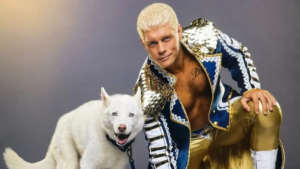
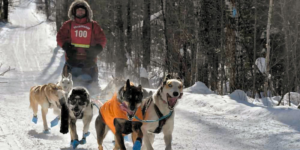
Brent Sass, originally from Minnesota won the Yukon Quest in 2015, 2019 and 2020.
Brent is well known for rescuing other mushers along the trail.
His lead dog, Silver lead to the introduction of the Yukon Quest’s Silver Award which recognizes sled dogs that have performed acts of heroism.
He earned the Rookie of the Year award in his first Iditarod in 2012.
Brent has also appeared on several TV shows, including Ultimate Survival Alaska and can be seen at the moment on Life Below Zero : Next Generation.
Faye spoke to Brent on the phone from his homestead on the outskirts of Fairbanks.
Let’s start with where it all began for you.
Why and how did you get into dog mushing ?
So I got into dog mushing – really it happened pretty quickly.
I moved to Fairbanks in 98 and I didn’t really know what a sled dog was.
And I was out on the trails.
And I had a, like a mutt dog, it was pulling me around on skis.
I was a cross country skier.
And I literally just saw this dog team go by at my feet.
And I had seen mushing and, you know, on the sports and the Yukon Quest and stuff, but never really showed much interest in those first years.
But when that dog team went by, right at my feet, like a spark went off in my head.
And I just said, I want to do that.
And then that really sent me kind of on the course that led me to get my first dog who was called Silver.
And then from there the rest is kind of history.
I just sort of built the dog team off from there.
But it was really that one moment that a light went off in my head, and I decided that, that’s what I wanted to do.

Moving to Alaska must have been both exciting and scary at the same time.
How did you decide where in Alaska to lay your roots ?
Oh, I first came to Alaska to go to UAS to go to college, it was kind of my excuse to my parents to be able to go to Alaska.
Go to college at UAS and that’ll get me to Alaska, because my big goal my big dream was just getting to Alaska.
When I was five years old, my grandma came back from a cruise in Alaska and she showed me the pictures of mountains and the ocean and everything.
And I just like told everybody right then that I was going to move to Alaska.
And so the dream sort of stayed with me my whole life and then UAS gave me the reason or the ability to move up here, right after I graduated from high school, and I skied on the university ski team for two seasons, and then after that was kind of when I got introduced to the sled dogs and the rest is history.
Wow. That’s a long time. Since five years old.
Yeah, I’ve been dreaming about it for a long time.
And now you’re living the dream ?
Definitely made it happen.
Where did your first dog come from ?
So my first dog came from actually that guy, that the first story that I told you, this team came by me.
It was actually that guy.
He came by and he was just a recreational musher in the Goldstream Valley, a place where I had a cabin just outside of Fairbanks.
And I actually found my way after that night that I saw him go by, I had recognized him as one of my neighbors.
And so I went over and started talking to him, and he’s a real, real eccentric guy, you know, he’s like a real bush man, living just outside of Fairbanks, but like a big gardener and really into all kinds of like, just Alaskan things.
And so I saw him as a person I looked up to, a person that I really thought I could learn a lot from.
And I told him I wanted to be a dog musher and I wanted to get into dogs and get some dogs and he said, come back in a couple of weeks and I came back and he handed me a dog.
And he said, Well, now you have your first sled dog and it was a puppy that was five weeks old.
And I named him Silver.
And then the rest again is history.
Silver became my number one sled dog and my number one leader.
He just died last year at the age of 18.
And so it was really Silver that got me into sled dogs.
That’s an amazing story for you to have seen his team and then get your first dog from the same person.
And 18 what a good age for a dog.
Yeah, it was awesome.
I had him for a long time.
What was your first race?
So our very first race was the Quest 300, which is a qualifying race, obviously for the Yukon Quest that started on the American side that year, and that’s a whole other story in itself.
But we actually went on to win the very first race, the Quest 300.
We were just like a bush team.
Racing was just kind of something I wanted to check off the list.
I was really into just traveling with dogs and going hunting with them.
And so I had a really tough team.
And it turned out there was a really bad storm during the Yukon Quest 300 that year, and we were really the only team that persevered through the storm and didn’t get held up super long.
And it was because of Silver, he broke trail for like, I don’t know, like 30 miles totally off trail and we found the trail again in the storm.
And it’s a really long story.
If you look up the 2006 Yukon Quest 300 there’s a lot of information on that race, but we went on to win it and sort of set the stage for the rest of our career.

How did you feel the first time you went out with a dog team. If you can remember that long ago.
I had a really makeshift sled, really kind of halfway done.
I had four dogs at the time that were just crazy.
I had Silver who was just a really young puppy who actually wasn’t in that first team.
After I got Silver as a puppy, I started collecting a few dogs from the pound here, the animal shelter and then got some free ad column dogs because I just wanted to be mushing like right away.
And so I had a total motley crew of dogs not really even sled dogs, it was like a Malamute and a Mackenzie River Husky mix and like a Pitbull mix and it was a really, really funny group of dogs.
But it was out of control and crazy, but it was the first time that I had ever hooked up my sled dogs to a sled and I knew that I was hooked at that point that I was gonna be doing this for a long time.
How long did it take you to master the sled ?
I don’t think I have mastered the sled yet.
I considered myself a pretty good sled driver you know.
Living in Eureka, we have really, wild trails and you have to really be on your A game all the time.
You can be as good as you can be, but there’s always obstacles and challenges out there that you can’t anticipate and that’s the thing that I love most about mushing, is that there’s all those things that you can’t predict and so you have to really prepare yourself for everything.
And then, if you know, if that means recovery time, then that’s what you have to be prepared for.
So I’ve been pretty lucky though.
I’m 41 years old and this is the very first bone I broke.
So I did pretty good.
Overall, how long does it take you to hook up a dog team, get them all harnessed and booted up.
It varies, a lot of times just because of weather and conditions.
Like if I’m going to have to put jackets on them and all kinds of other protectors and stuff.
It takes a lot longer, but I have really well trained dogs and they do a lot of the work for me.
Like I go around to their spots and I put their harness on and then I let them run loose and they run all over the place and burn a bunch of energy.
By the time I have all 14 dogs loose, then I’m able to go up to the line and they all just kind of file over and I hook them into the line and then at that point I’ll put booties on.
I can bootie a 14 dog team in under 14 minutes, less than a minute a dog.
So maybe, you know, maybe 25 minutes if I’m really on my A game and the dogs are behaving well.
But they do a lot of the work which is nice.
They listen well and I don’t have to drag them around or anything like that.
They pretty much run around and come right to the line and let me hook them up.
So we’ve refined a pretty good process for that.
I wish my dogs were like that.
Mine are totally the opposite.
If I let mine loose they would run away and never come back.
It takes a lot of training and a certain kind of breed for sure.
Do you have the same training routine every year ?
My training routine, I think the base of it is the fundamental sort of theory behind it is pretty similar, you know.
I run the dogs pretty consistently, they almost get run every day, there’s not a lot of like, extended downtime.
That’s kind of the theory behind it.
I run the dogs through the races, which most I would say, up until this season, that has been my main, you know, sort of rules for my training, you know, the amount of miles, that is always changed every year.
And then the conditions clearly, you’re just kind of up to whatever Mother Nature throws at you.
It’s the kind of training whether you get a lot of tough training in the wind or the snow or if it’s a real dry season where you’re fighting really fast, hard trails and bumpy conditions.
So every year is different for that. But this year, that’s a really good question, like this year, one, having no Yukon Quest 1000 mile race.
Which means that I wouldn’t be running 1000 miles right before I go to Iditarod.
On top of that I just injured myself.
And so the dogs are getting very, very low miles and slow training and small teams with my handlers now, which will be a very different training program for this year.
So it’ll be the first time and in probably 10 years that I’ve really been racing competitively, that things have been really shifted around.
But I’m looking forward to it.
And I got a lot of miles on the dogs early on.
So I’m really confident in their durability.
But it’ll be interesting to go to the race with such a fresh team.
I’ve never gone to the race with a dog team that hasn’t just run the Yukon Quest.
So every year is a little different.
But I think my main philosophy, to get back to your question, is pretty much the same all the time, run the dogs, keep them moving.

You are a three time Yukon Quest champion. Out of the three races, which was your favourite ?
Well, that’s a tough one.
I would say, the first one was probably my favourite.
You know, obviously, the first time you win, it becomes a reality to you.
It was a dog team I had trained a long time and we raised from puppies.
It was a real wild race.
So it was really, really fun to win that one.
But it’s pretty tough.
My 2019 Quest win was also something after I basically had raised a whole new team up and was just going into the race.
It was their very first race for most of the dogs in the race.
And so we were just going into that race to finish and have a good time and get the dog over the trail.
And they just ended up being amazing.
And we ended up winning.
So it’s hard to single out either one of those two as being my favourite.
And then of course, the repeat, it’s really tough to not have the repeat be your favorite too.
So it’s hard to pick one.
Obviously, a lot of hard work goes into looking after your dogs. But what does a normal day comprise of ?
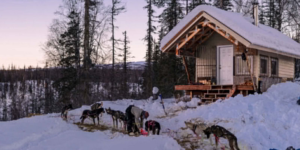
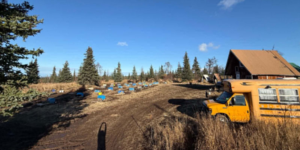
Well, you know, living where I live, the dogs are clearly our number one focus, but we also live way off in the middle of nowhere out in the bush.
We don’t have any, there’s no services or anything.
So we have to do everything.
We cut all of our own firewood to heat all of our buildings with wood.
And so our day, you know, in the middle of the training season, I have a whole crew that’s helping with all of that survival stuff.
And for me, I’m lucky to get up and be focused mainly on the dogs, you know, I’m a fixer.
So if anything’s broken, that’s the first thing in the morning I’ll go around.
And if the handlers have some issue or something’s broken, I got to go around and fix that.
But then my day goes straight to the dogs and during the middle of the training season, I’m spending anywhere from, you know, four to 12 hours a day on the runners, for long training runs.
And then you’re back home.
You’re feeding the dogs, you’re taking a nap for three or four hours and then I’m usually back at it.
I generally sleep about four hours a day, in the wintertime.
Just between all the general survival stuff at home and then the dog training.
That’s about all the time I have for it, and I can pretty much sustain that.
It’s also really good training for the race.
Gosh, that’s a busy day. It must be really difficult for you, like now then, with you not being able to do the things that you used to doing everyday while you’re resting up ?
Yeah, it’s torturous.
But I’m not at home for that reason.
I’m in Fairbanks.
I’m staying with a friend here in Fairbanks.
Because if I was to go home right after I had my surgery, it would have been really, really difficult to just not do anything, you know.
So I stayed in town for a week.
Now I’m heading back tomorrow to the homestead so I can be around the dogs and play coach more than anything at this point.
But yeah, it’s really difficult.
It’s not ideal.
But I also know that if I take care of it, and if I relax now, that I hopefully can bounce back pretty fast.
What is your favourite race and why ?
The Yukon Quest is definitely my favorite race, the full 1000 mile Yukon Quest.
And I think more than anything, it’s the places we get to go and the people we get to meet along the journey along the race.
It’s such a community event, and that’s one thing I’m really missing this year.
You know, 13 out of the last 14 years, I’ve run the Yukon Quest.
And so it’s a tradition.
It’s like going to see your family, your extended family, out there on the trail, and you’re using your dogs to get from point A to point B and you’re seeing all these people that you see just once a year and hanging out with them and you’re sleep deprived and you know, in your travels with your dogs, but they’re there to help you and support your race in any way possible.
And it’s something that’s really unique to the Yukon Quest, I think as far as all the hospitality and stops along the trail.
So that’s definitely my favorite race, and I’m definitely gonna miss it this year.

Tell us about your awards.
The ones I’m most proud of are the choice awards that I’ve earned.
Two of my three victories in the Yukon Quest, I got the best choice award.
And to me, that’s the pinnacle of this sport and of this lifestyle, is being recognized for taking care of dogs.
There’s just no better thing, because the dogs are the number one point in all this and the better you take care of them, the better race you’re probably going to have.
And it’s really just awesome when people around, not only you, know you take good care of dogs.
But it’s fun to see that other people are noticing, especially the vets out on the trail.
So I think those are the ones I’m most proud of.
Early on in my career, I got a lot of sportsmanship awards.
So I was able to help a lot of people on the trail.
Back before I was running in the front of the pack, I felt like I was sweeping up behind and able to help a lot of people down the trail and when they needed help on the trail and Silver also played a huge role in that.
So the sportsmanship awards that we earned during our first, you know, several from five to six years of our racing career are something that we hold pretty dear to our heart.
And that’s something that clearly, you know, the dogs and I, both the vets choice and the sportsmanship, we know it’s a team effort to get to achieve those awards.
And then there was the Silver Legacy Award which was given to Silver, my main lead dog, because he had a lot of different times out there where he pulled me and other teams through storms and saved people a few times that we’re in some real peril.
So the Silver Legacy Award has only been given out once to Silver in 2013.
And for the Yukon Quest.
And so that’s a pretty special award.
But who knows if it’ll ever be given out again.
We hold all those pretty dear.
Wow, that’s awesome. That first dog that started it all for you. And he got the award. That’s amazing.
Do you get the same level of excitement to run the Iditarod every year ?.
Oh, yeah.
I mean, my level of excitement is always extremely high.
I’m always really excited to be on the trail.
I think it morphs a little bit, you know.
In your first years, you’re just that excited to be there, you’re excited to be on the trail and see the new things and see all the new places and go there with your dogs.
And then the more that you run it, you know, especially for someone like me who’s competitive and whose goal is to win the Iditarod someday.
You know, you get more focused and your enthusiasm and excitement changes in its form, maybe a little bit more towards your anticipation and all the things that you need to do right in order to have that perfect race that would, you know, allow you to be in the front of the pack and vying for the win.
So I think the excitement has sort of morphed over the years.
But I still have that like just pure excitement to be traveling with my dogs for 1000 miles.
It’s kind of like the pinnacle of the whole season you know and for us like once we get out on the trail, it’s almost like a vacation.
You know, my normal day is much easier when all I have to do is focus on 14 dogs and me and surviving on the trail, instead of having to keep, you know, a kennel of 60 dogs operating and running in the middle of nowhere.
So on the race, once all that prep is done, once you actually get out on the trail, it’s a lot like a vacation.
How do you personally prepare for such a long race not knowing what lies ahead of you ?
My everyday life is something that prepares me for that, because I don’t know what’s gonna happen every single day when I open my eyes and get out of bed.
You know, I don’t know what I’m going to be fixing.
I don’t know what’s going to go wrong or what’s going to go right or what dogs I’m going to run.
I leave everything sort of to let itself play out every day.
If you try and plan and schedule too much in the lifestyle that I have, all you’ll be doing is disappointing yourself.
So my everyday life prepares me for the challenges and the unknowns that we get faced with out on the trail.

Tell us about your team for this year. What are their names and positions ?
Well, right now I’m training.
I trained 27 dogs at the beginning of the season and I’ve whittled that down.
I had 25 about midway through and now I’m down to about 20 dogs.
But of those, 14 will be there in the race this year.
It’s pretty tough.
I can name off a few of them and give you the rundown on them.
But there’s still a pretty big pool of dogs that are running for the race.
And now with me going down and having my handlers just run the dogs.
I’m kind of just maintaining and I’m gonna have some really tough decisions to make, come race time.
But it’s a lot of the same dogs from last year.
I have a litter of puppies that were named after a movie called Dazed and Confused – Pink and Slater and Woody.
Those three are three of my main lead dogs.
They were two year olds in our 2019 win and have just ripened into amazing dogs and they’ve made a huge push this year in confidence.
And so those three will be my main leaders.
Morello is one of my main females, she’s another leader.
Most of my dogs lead.
So almost all of them are leaders that I’ll bring to the race or only be a couple of dogs that trained as lead dogs will run in lead at some point during the race.
I rely on a lot of leaders.
I have a bunch of superstar leaders.
But I try not to ever put too much pressure on them and really mix it up out there on the trail.
So pretty much all my dogs are leaders and then I have Lucy and Ursa and Tock are three of my other main females.
I’ll probably have six females in my team this year.
And it’s the most females I’ve ever had.
I generally lean heavier towards the male side of the kennel but this year sort of breeding influence over the last couple of years, I’ve got more females, so those girls are going to be rock stars.
They were all in my team last year and are just really good.
Arlo will be the last girl and she’s a total rookie.
She’s turning three but she’s never ran any race before.
And, she’s been strong all season.
So she’s kind of my wild card girl that I’m probably going to bring along and really have high hopes for.
And then I’ve got my old guys Sluice.
He is the oldest dog in the team.
He is nine and I kind of actually anticipated on retiring him this year, not thinking that he would be able to keep up with all the youngsters, but he has thrived.
He will be one of my main leaders and has been one of my main leaders for the last, basically six or seven years.
So he’s kind of the main veteran guy in the team.
Jeep will be back.
Jeep is the only dog in my team that I haven’t raised from puppies.
He comes from a sprint master named Joee Reddington, who was a real big mentor of mine.
And he got thrown in my team back in 2019.
And he’s been a superstar ever since.
So he’s another one of my main leaders, and he’ll be in the team.
And then Captain and Hero, they’re brothers.
They were both in my team last year, and actually Captain was in my team in my mid distance races, but didn’t make the big team.
So this year, I think they’ll be back.
So it’s a real family affair.
Almost all these dogs are related in one way or the other.
There’s only two dogs in the team that aren’t related back to Silver, my main leader, that was my very first sled dog.
So the team really means a lot.
It’s mainly grandkids and kids of Silver.
And so it’s a real family affair out there on the trail for us.

So what do you look for in a lead dog ?
Confidence is probably the biggest thing.
I mean, you can see that at a really young age.
And so the confidence that the dog has, if they have confidence, man, they can go a long way in building that confidence.
So what we work on, when they’re really young, so I start leader training from the day they’re born, basically.
And then you can start doing all the things that they need and give them all the equipment, they need to be a good leader.
And then as they get older, you would really sort out to see who really has that mental ability and that confidence to really thrive in any condition.
So confidence is a huge one.
And then, you know, just their ability to bond with you.
You know, a good leader has got to be a dog that can really bond tight with you that you have the utmost trust in and they have that trust in you.
Besides mushing, what other interests and hobbies do you have ?
Well, I used to have a lot of them.
But now pretty much mushing is everything.
I love to hunt and fish.
I mean, I don’t do a lot of fishing anymore.
Just because of where I live, there’s not a lot of opportunity for a bunch of fishing, I usually go on a couple big fishing trips every year to put some fish in the freezer.
But I’m an avid hunter.
You know, I survive on moose meat.
So every year I get a moose and usually a couple of caribou.
And just wilderness travel, I just like being outside.
Like I’m pretty much doing everything with my dogs outside.
It’s my biggest hobby.
When you leave this world, how would you like people to remember Brent Sass.
A nice guy who lived the dream, you know, followed their dream and hopefully, you know, inspired a few other people to do the same thing.
I think in the end that’s kind of in the back of my head like I know it’s possible.
I did it.
I live the dream.
And so I’m living the dream right now.
Even if I lay here with a broken collarbone.
I’m living the dream and if I could inspire someone else to follow their dreams and go after what they want to do.
That’s kind of how I’d like to be remembered.
Having filmed the latest season of Life Below Zero Next Generation, a lot of people will now know you from TV.
To those who enjoy watching you live your dream, what advice would you give to someone who also has the same dream but maybe too afraid to go for it ?
Oh, man, be fearless.
Take risks.
I mean, in the end, like some people might not think that’s the greatest advice.
But the only reason that I was able to make it and be doing all the things that I’m doing and living my dream is because I took risks.
I just decided that I really wanted to do something and in order to really be able to do it, you got to take some risks.
So go after what your dreams are.
Don’t let anybody tell you, you can’t get there.
You’ve got to take risks for the things you love haven’t you ?
Do you have a favourite dog?
Oh, man, I don’t think I could have a favorite dog.
I mean, I can say that my favorite dog was Silver.
He definitely was the foundation of the whole kennel.
And obviously he’s not around anymore, but I try not to play favourites.
You know, I would say that every one of those dogs in my main race team, we are so bonded and so connected.
That I really honestly can’t play favourites.
I love them all.

How does it feel to raise your own pups, train them then race them ?
That’s the most gratifying thing about the whole process.
You know, that for me in the beginning, I kind of made that call that I wasn’t going to be someone that bought a bunch of dogs and ran 1000 miles.
Like I wanted to raise the dog, pick the breeding, raise the dogs and train them and race them.
That’s something that I stand behind is one of the biggest things that has led to the success that I’ve had, is that I’ve, you know, stuck to my own genetics and really just worked with dogs that I’ve known their whole entire life and never really given up on them.
You know, dogs don’t always mature at the same speed and I’ve had really good luck with just kind of holding on to dogs and let them prove that they got what it takes.
I get that it’s much more rewarding to have raised your own dogs and raced them.
What kind of things are packed in your sled during a race ?
So all kinds of mandatory stuff we have to carry which includes an axe, snowshoes, the sleeping bag, dog cooker, which we use to make hot water for the dogs on the trail.
And then we always have booties for the dogs and most recently, the Iditarod has made insulated jackets for each one of the dogs, a mandatory piece of gear as well.
And then on top of that, clearly we have all the food that we need for both me and the dogs.
And mainly it’s the food and that mandatory gear that you got in there and also a lot of, you know, dog first aid and the things you need to take care of dogs out there.
You know, shoulder coats and wrist wraps and all the stuff you need to be able to heal up any nicks or dings, dogs might get on the trail.
And then a lot of, you know, water.
I carry a lot of water bottles and hydration is a really big thing for me out there and a lot of good food.
I eat a lot of soups and stuff, that type of thing is the stuff we always have to have in our sled.
If I’m not gonna replace my energy, there’s no way that I can take care of dogs properly.
So that’s one of the biggest things I’ve learned over the years is to have a lot of that stuff in your sled.
That’s a lot of stuff. Does your sled get heavy with all that in it ?
Yeah, I mean, that’s one thing with the Quest, you know, we travel 200 plus miles between checkpoints sometimes.
So we have 250 – 300 pounds of gear in the sled for basically two days or more that we’re out traveling.
So yeah, the sled gets really heavy.
I train with a really heavy sled just because of where I live.
Basically every time I pull out of the yard, I have a fully packed sled going on a 200 mile trip.
Because there’s no assistance out there.
There’s no help and the dogs might as well get used to hauling a big load.
Feeding regime is very important for working sled dogs. What do you feed your dogs and why?
Feeding regime is huge.
Clearly their nutrition is one of the most important things for the dogs on the trail.
I feed a really high fat and high protein, really high performance kibble called Inukshuk.
And I’ve been happy with that food for a long time.
It’s a food you can feed alone.
You don’t have to feed anything else.
It is so high in fat and protein that it really provides dogs what they need.
But we also feed a lot of meat, beef and tripe and liver and fish and chicken.
All that type of stuff gets fed to the dogs throughout the season.
They burn over 10,000 calories a day out on the trail.
So it’s our responsibility to replenish all that.
So you need a really really good feeding program to do that.
Your dogs sound like mine, they eat better than I do.
Do you have any tips on how to train dogs the commands they need to know to drive ?
Oh man, I mean, the biggest thing, my tip, is start young, start early to train the dogs.
The little things, if you train dog little things, when they’re young, it makes them much more susceptible to like being able to learn things as they get older and that’s one thing I learned, is that a puppy that’s had a really good socialized training, got to run a lot, got exposed to the harness did all those things, it made it way easier to train the dog down the rest of their life.
So I think it all starts from puppies.
Do you believe that man and sled dog team work as one because of the special bond that’s between them ?
For me, I could never go run a race if it was dogs that I wasn’t bonded to.
If I wasn’t bonded to the dogs, if I didn’t have that connection of 1000s and 1000s of miles training them, I don’t think that I would get nearly the gratification from running the race as I do with the dogs that I’ve spent their whole life with them you know, so I think that is the key thing for me.
Do you also believe you can read your dogs ?
Yeah, I definitely believe I can and I believe they can read me.
I think we definitely have a way of communicating and I mean even with this accident that I just had, like the dogs could have made it a lot worse.
But they listened.
They heard the intensity in my voice.
They understood that when I said Whoa, and Stop, and Hey, you know, I need to take a break for a minute here.
They listened and then I had to go another eight miles after I broke my collarbone and was pretty out of it.
And they took it easy and slow and they realized that like I wasn’t 100% and they made that last eight miles possible.
So yeah, I fully believe that the dogs read me and I’m able to read the dogs.
How hard is it to train for a race if there’s little or no snow ?
Yeah, it definitely makes it a lot harder.
I’ve had plenty of seasons where I’ve had to train with a four wheeler, or you know, well into December, you know, well into the time when you want to be on a sled already, and it makes it a lot more difficult.
You can’t simulate the sled like a sled.
It’s just the wheeled machines and the noise and just the different ways that it pulls and the different places you have to go to do the training.
It definitely changed it.
It’s possible.
I mean, I’ve made it to the race when I’ve been on a four wheeler for almost the whole season.
And, you know, I think more than anything, you’re just more ill equipped because you haven’t been driving a sled all season.
So yeah, it’s possible, but it’s not nearly as fun.
So would you say it was harder or easier on a sled because over here in the UK we hardly ever get snow at all ?
So we’ve got what’s called three wheeled rigs. I’ve never gone on a sled in snow.
Yeah, for me, it’s much easier on a sled only because I love being on a sled and I hate being on a four wheeler.
So it’s much easier to sled.
There are a lot of benefits to doing it on a four wheeler.
You generally can control a bigger team, you know, you might have a little bit more control on your machine.
If you have a really big machine, you might have a little more control of the dogs if, you know, if they’re unruly.
But that just goes down to the training and I trained my dogs to be very calm when they’re not running and to not be banging the harness or anything like that.
So for me, the sled is a much easier way of training the dogs.

Can you see yourself running the Iditarod for several more years to come ?
Oh, yeah.
As long as there’s a race, that I’m able to do it, and I’ll be out there doing it.
So yeah, I can’t imagine hanging up the towel anytime soon.
What is your ultimate dream or goal ?
Well, I mean, my ultimate dream or goal since I started this dog thing was to win the Yukon Quest and the Iditarod.
So I checked the Yukon Quest off three times.
So now it’s time to focus on the Iditarod.
And, you know, I would really like to win the Iditarod, there’s no doubt about it.
But in the end, like I’ve had such an amazing journey, and I am just so thankful for everything I’ve done.
So I’ve checked off so many goals, so many, goals throughout the years.
But the ultimate one right now is definitely, definitely, winning the Iditarod.
Sadly, there are people in the world who think racing dogs for such long distances is cruel, and keeping them on a pole is cruel. They do not understand the concept of either.
What would you say to these people ?
You know, these dogs are bred for doing exactly what they’re doing.
And I think that the only way you can really see it is if you just pay attention.
Follow my Facebook page.
That’s what I would say.
See a whole bunch of dogs living the dream.
Yeah, in the end, visit a kennel and talk to a musher.
Don’t listen to big corporations or big groups of people that are trying to spread all these false rumours.
I would say if you really want to know what these dogs and what this sport is all about talk to a musher.
I mean, you can tell in my voice right now we have more passion and love for what we’re doing.
And the last thing that we would want to do is hurt our dogs.
So, I mean, I think that’s the best way to tell someone or to talk to someone like that is to say, talk to a musher.
And I think they’ll convince you pretty quickly that what we’re doing is what’s best for the dogs.
Wild and Free is such an excellent kennel name, it simply says it all did you think of it and why?
Well, the inspiration comes from a song called Wild and Free by a guy, a good friend of mine, named Hobo Jim.
He was Alaska’s balladeer, and he performed in a lot of bars throughout the state when I first moved here and I heard him sing that song a couple of times.
And a light went off in my head and was just like, man, this song kind of tells the story of my life a little bit, you know, or a lot of people’s lives, but I really related to it.
And I decided that there would be no better name for my kennel than Wild and Free.
So sharing your life with dogs is pretty damn special. But sharing the same passion for dogs and running them with somebody else who has the same passion.
Tell us a bit about Ida.
So Ida has been a great partner and she you know, she loves the dogs as much as I do.
And I think that for me is a really big part of it.
You know, the only way you can really live this lifestyle is if dogs come first and so you know she definitely lives by that mentality.
And has been a great addition to both my life and the dog’s life.
What advice would you give to anybody who wants to start mushing but has no idea where to start ?
I would say talk to somebody who’s doing it.
Talk to an experienced person, whether they’ve got six dogs or 60 dogs, someone who has been doing it knows what it takes, because everybody, you know, I think no one really completely understands until you actually have dogs, the effort and the amount of money and everything, and the time and energy that you have to put into your dogs to do them justice.
So I feel like talking to somebody who’s done it, who’s doing it, who can give you advice on how to get started and what it actually is going to entail.
So you can make an educated decision on moving forward.

What is the atmosphere like at the ceremonial start of the Iditarod ?
It’s high, it’s great, it’s a great get together, I’m gonna kind of miss that this year.
I’m sure there’ll be something but it won’t be quite the energy because there probably won’t be the crowds.
But, you know, the dogs sense the energy and everybody around and it’s just a really, really great time, a great celebration of a great race.
And, it brings out the fans.
And you know, the fans play such a huge part in our sport.
And it’s one of the few times that we can all be out there, celebrating together.
Must be amazing. But it’s gonna be really weird this year as well.
Describe one moment from any race when you’ve crossed the finish line.
Oh, man, I probably have to say that the first Yukon Quest victory was absolutely amazing.
I mean, coming into the finish line, there were literally 1000s of people on the streets of Fairbanks.
I was finishing, you know, in my own hometown area, and I live outside of Fairbanks, and the crowd was amazing.
And all my friends and family and it was such a celebration, because I’ve been working at it for so long to get to that point that I had so many people that believed in me and they were all there.
And it was really fun.
And it was partial, extreme excitement and partial, like, totally surreal.
And I was just like, totally relieved.
Like I couldn’t believe that it had actually happened like I had actually won the Yukon Quest.
Oh, that must have been amazing. I can only imagine how you must have felt.
Have you ever had an accident whilst on your sled ? What happened ?
I’ve had few of them, I’ve come off several times.
But this one here, this last one, was probably, obviously the most dramatic.
I have never broken a bone in my body until now.
So this one was probably the worst.
And, like you say, you go out every day, like I’ve been mushing for 16 years, you know and never broken a bone, never had as violent a crash as I had just last week.
But you know, that’s what comes with the sport.
It is what it is and you just recover and move on.
What have you learned from living the lifestyle that you now live ?
Wow, I’ve learned a lot.
But basically what the biggest lesson I’ve learned is to keep a positive attitude.
Because in my lifestyle if you get bummed out or get, you know, depressed about anything and let small things get to you, you will not survive.
That’s basically the bottom line.
You will not survive if you get bummed out and have a negative attitude.
So I think keeping a positive attitude and marching forward is probably the biggest thing that I’ve learned from this lifestyle and from the dogs.
Dogs exude that positive energy.
And I feel like the dogs sort of help you along with that.
Would you change anything ?
No.
There’s probably all kinds of small little things I would change but in the grand scheme of things.
I am extremely happy with where I am and what I’m doing.
And just extremely fortunate that I get to be doing what I love to do every day.
Do you have any tips for somebody who is about to go on a sled for the first time ?
Relax.
Bend your knees.
Don’t forget you have a brake and relax.
Because the two biggest things people do is they stiffen up and are just like a board when they’re standing there.
And then they forget that they have a brake.
So remember, you have a brake, and be loose.
Who out of all the mushers over the years, is your idol or inspiration ?
Oh, wow.
I probably have a couple of them.
But I mean, I would say, you know, I have two of them, really, or maybe three of them.
Dave Munson and Susan Butcher were some of the first competitive mushers that I was associated with, and they were the ones that kind of got the racing spark into me and sort of facilitated getting me into my first race and lit the fire.
I traveled 1000 miles with their dogs first, just on a Serum Run, just for fun.
And so they kind of lit the fire for me.
And then once I got the fire from them, Lance Mackey is someone I always looked up to, and someone I really based a lot of my training techniques off of and he opened his, you know, array of information and knowledge to me when I was a young musher.
And yeah, I kind of based you know, between Silver and Lance is pretty much where my genetics come from as well.
So, from a dog standpoint, and just in a person who clearly can keep a positive attitude to the worst of the worst, Lance has been definitely one of my heroes.

Me too.
Your life to me just sounds so surreal, because it’s just something that someone like me could only just dream of.
So you recently had your annual visit from Lloyd.
Can you share with us one of the stories he’s told you about driving dogs in the olden days over your Eureka Pass ?

Yeah, he told me a story once about going over to the top and got to the other side and all of a sudden the snow was really deep.
And there were a bunch of horses right in the middle of the trail.
And he was heading to Rampart, which is about 30 miles from there.
And he said, there was a goat too.
I guess that was there with him.
It was a local guy who had horses and the horses were on the trail, and they got freaked out by the dog team.
And he basically chased the horses all the way to Rampart.
And horses got 20 miles from their home or whatever, but they couldn’t get off the trail, to get out of the way.
He tried to get out of the way, but they wouldn’t cross over in front of the dogs.
And so he ended up going all the way to Rampart with a herd of horses.
That was one of the good ones.
Do you hire a different dog handler every year ?
And what do you look for in a handler ?
Yeah, I have a different one every year.
You know, any year that someone wants to come back, if they were a good handler, I’ve had several that have come back year after year.
Which is a huge essential thing for me.
And the dog is a huge plus.
But generally we have new handlers every year.
And it goes back to that same thing.
I look for people with a positive attitude, and a hard work ethic.
Because it’s a lot of work to live out there.
And it’s you know, you’re not around people, you have to be really self motivated.
And, so you’ve got to be someone that’s really self sustainable, basically.
But having that positive attitude is the number one thing.
Would you say that someone who is unfit, but determined to move to Alaska to live a subsistence lifestyle and run dogs could become fit and make a go of it ?
Yeah, I think anything’s possible.
It’s just a matter of how bad you want it.
You know, it’s a matter of how bad you want it.
If you got the resources and the support to make it happen.
I mean, I don’t do this alone.
I have a huge support group from my family and friends.
All the dogs I have, I mean, there’s no way I could do without all of them.
So you got to make sure that, you know, going off and doing something all alone in the middle of the woods is kind of a fantasy.
I mean, there might be a few people that do it.
But in the end, like the saying goes, it takes a village.
So I would say, you know, get good people around you in order to sort of make that goal happen.
Can people sponsor your kennel ?
Yep, you can go to my website.
There’s a lot of different options to sponsor the kennel.
You know, we have a dog sponsorship program that we do every year.
This year, all of our dogs are already sponsored, which is excellent.
We have a lot of support, that way.
You can sponsor booties, you can sponsor checkpoints, you can sponsor just about anything.
If you check out our website, wildandfreealaska.com.
And there’s lots of options there.
Do you also do sled dog tours ?
We do little tours.
You know, we haven’t done any this last year.
My biggest thing is, I do expeditions up in the Arctic in April.
So after the race season is over, we set up a base camp, way up in the Arctic, and we do expeditions up there.
And so that’s kind of the biggest tours that we do.
And you can find all that information on the website as well.
What to do your fans mean to you ?
Oh, man, they mean the world to me.
It’s amazing.
You know, it’s crazy when you’re on the trail, and you’ve went a whole season and you’ve gotten all this support from all these different people from all over the place, and you’re out on the trail and you know that all of them are back at home watching the little computer screen to watch my little dot.
It means a lot.
There’s many times out there when I think, wow, there are 1000s of people that have all helped make this possible for me right now, me and the dogs right now.
And it’s great to know that they’re all watching and following.
So yeah, I really appreciate all the fan support, that I have.
Definitely have great fans and loyal ones.

How hard is it leaving your old lifestyle and everything that you were used to, to learn a new way of life in Alaska ?
Oh, man, it wasn’t hard at all.
Mainly because I was 18.
And I was ready for something different.
I knew that my calling was in Alaska and in living that kind of lifestyle.
So for me at 18 because I did it so young.
And I kind of just flowed right into it and started, you know, first moving to Alaska, then living in a cabin, then moving a little bit farther out of town and then moving a little bit farther out of town.
I sort of built myself up to be able to live the life that I live right now.
Does your girlfriend, Ida, plan on running the Iditarod one day ?
Erm..no ! Well, every now and then.
But she really likes her sleep and likes playing a bigger role behind the scenes.
I could see her maybe running a shorter race but not a 1000 mile race.
How different is being out on a night run compared to being out in the daytime ?
I mean, they’re both just different in their own ways.
But at night the dogs seem to be always faster and more excited and more focused in the night runs.
And of course there’s always the possibility for Aurora which is awesome.
So yeah, I really enjoy training at night.
I always feel like dogs are a little bit more focused.
But then again, you’re missing some of the scenery, too.
So it’s kind of a toss up between what my favorite is.
Say someone is reading this interview right now and thinking to themselves is a sled dog for me, should I get one.
What would you say to anyone thinking of becoming a first time sled dog owner ?
Be ready to be active.
Sled dogs like to move.
They gotta move.
They gotta run.
They gotta have an active lifestyle.
So if you’re someone who likes to sit on the couch, then don’t get a sled dog, because they’ve got to go all the time.
That’s the one thing that I’ve learned over having owned hundreds of them.
I know that they are very, very active and love to move.
Living hundreds of miles from the nearest road you pretty much have to fend for yourself.
You hunt for your food, you fish, you use hides for clothes and blankets, you use trees for your firewood, use lakes or ice for water.
So where does the musher in the middle of nowhere get straw to bed the dogs down from ?
We still go to town.
Each fall I do a lot of supply runs to haul all the dog food and all the gear and supplies that we need out to the homestead before the road closes.
I basically have to go to town and resupply every now and then.
So we try and, you know, live off the land as much as possible.
We still do quite a bit of shopping in cities as well.
But it’s just very limited times, and then usually lots of couple of really big shopping trips a year.
How do you get a phone signal or internet connection in the middle of nowhere ?
We have a satellite internet and we have kind of a crazy setup because the dish tends to be on the top of the mountain away from the homestead.
So we have kind of a bush setup.
But yeah, we have satellite internet.
That’s how we get our connection out at the homestead.
Is Brent Sass, a future Iditarod champion ?
Yes.
I feel like we’ve got as good a chance as anybody else and I am really confident in my dog team and I can’t wait to get out there.
I have to say, Brent, I’m really honoured to have done this interview with you.
Thank you so much for taking the time out.
Make sure you do spend a lot of time recovering.
I know when I had my tumor removed, it was an absolute nightmare because I wasn’t allowed near my dogs in case they jumped up at me or anything.
And I’ve just got to be like you, on the go all the time.
But I was told to rest and I didn’t listen.
So please rest so that you make it to the Iditarod.
That’s the goal.
Hey, I really appreciate you being really persistent with me.
Sorry, took me so long to get tied down.
But I’m glad we finally made this happen.
It’s fine. I totally understand.
I mean, I’ve only got 15 huskies. So compared to your 60 and I’m on the go all the time.
So I don’t know how you do it.
But keep living the dream. I will get there one day.
Okay. All right. Thank you.
Bye.
Bye

A huge thank you to Brent for taking the time to speak to Faye on the phone, particularly when he is resting after his accident.
If you want to find out more information about Brent and his dogs and his lifestyle you can see him on the National Geographic program “Life Below Zero : Next Generation“
There is also still time to sponsor Brent before he takes part in this years Iditarod. Find out more how you can help out at wildandfreealaska.com