Rob Cooke, was born and raised in Worcester, England. He received his B.A. and M.A. in Humanities in the United Kingdom.
Having spent 23 years in the UK Royal Navy as an aircraft technician and then as an engineering officer, he retired in 2005 to live in Canada and pursue the dream of racing the Yukon Quest with his own Siberian Huskies.
In 2013, he realized that dream when he crossed the finish line in Fairbanks. This just inspired him more, so in 2015, he entered both the Yukon Quest and the Iditarod and became the first purebred team to finish both 1000 mile races in the same winter.
He has a kennel of AKK, CKC, and UKKC registered Siberian Huskies. One litter, the Crazies, between them have finished 23 1000 mile races. Rob is a member of the Siberian Husky Club of Great Britain and is married to Louise. He says he has “no” hobbies!
Being from the UK, have you competed in dry land mushing and taken part in UK rallies ?
We started out doing dryland mushing in the UK. Initially it was to keep the dogs in shape as Louise wanted to show them but I soon got hooked. I think the first race we took part in was the SHCGB race at Abbeycwmhir in 1999. We then did Fineshades a few weeks later and on to our first Aviemore which I guess must have been in early 2000. We raced a lot up until when we left the UK in 2005, mostly with SHCGB but also ABSA, SSHC, AMWA and BSHRA.
How does dry land mushing on a rig compare to on a sled in snow ?
I seem to remember falling off the sled an awful lot when we first moved to Canada – not sure if that counts as a comparison.
I guess one of the biggest differences is distance and so time spent on the sled compared to the rig.
Although we did used to take part in the Aviemore trek, and did at least one longer (maybe 10 miles) race before leaving the UK, as soon as we started training in Canada we were training for mid distance so initially 30 to 60 miles then 100 miles +.
I think running on the sled became more relaxed (if that is the right thing to say) – not so much running for me :)
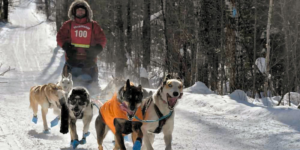
We are also able to run much bigger teams on the sled – typically now I’ll run 12 to 14 dog teams comfortably and often run 16 dog teams.
In the UK mostly I ran 3 or 4 dog teams and very occasionally ran 6.
The very last time I used a rig was in Canada with an 8 dog team and it did not go well, we were lucky to all walk away in one piece; I swore then I would never run more than 6 dogs on a rig again.

I understand you chose to move from the UK to Canada, why was this ?
The reason for moving to Canada was entirely to see if we could raise and train our own dogs to take part in the Yukon Quest.
Since emigrating how has life changed for you ?
I think life has changed a lot.
When we moved to Canada we had 9 dogs, today we have 56 and at the maximum we probably had close to 70 dogs.
This isn’t meant to sound patronising because even when we lived in the UK our lives revolved totally around the dogs, but I think back in the UK mushing was more of a hobby, something we did in the evening and at weekends – today my life is totally immersed in the dogs; everything we do is about the dogs.
I get up at 4 am to run dogs pretty much every day; in the winter as soon as I finish work I go outside to run dogs and will often be out until after midnight – pretty much every penny I earn goes on the dogs whether that is feeding, supplements, housing for the dogs, mushing equipment.
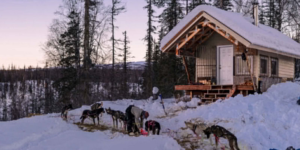
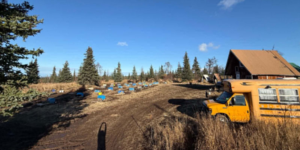
I live in a remote location just so I can keep this many dogs and mush from the yard.
I work purely so I can afford to keep this many dogs. All of my plans and life is focused on what races we will do the next winter. Mushing now is a complete lifestyle choice.

When did you first know a sled dog was the dog for you ? Can you describe getting your first husky ?
Because I was serving in the Royal Navy at the time we wanted to get a dog that could keep Louise company whilst I was deployed.
We also used to do a lot of hiking and so wanted a dog that could keep up with us.
Louise’s dad sent a photo of a husky wearing a pack and accompanying some hikers and so we thought that would be the dog for us.
Ironically shortly after getting Siberians we found we no longer had the time to hike.
It was pretty difficult back in the 90’s to get Siberians in the UK, you really needed to be recommended by someone who already owned the breed.
We approached the SHCGB and they recommended we speak to Nigel and Sonya Richards; we were living in Cornwall at the time and Nigel and Sonya were pretty much the only people in the South-West with Siberians.
We visited them and their pack and were not put off by the outgoing nature of their pack and eventually they put us in touch with Sue Sercombe and from Sue we got our first and third Siberians.
How many dogs are currently in your kennel and which ones are on your team ?
Today there are 56 dogs in the kennel, one Karelian Bear Dog and 55 pure-bred, registered Siberian Huskies.
This winter I am training 32 dogs so all the others are retired – dogs are with us for life so once they retire from racing, at around 10 or 11 years old, they still have a home with us.
Of the 32 in training only 2 are not from our own lines – the other 30 all go back into the dogs that we brought across from the UK, mostly second and third generation from one bitch, Penkhala’s Medea at Shaytaan bred by Alan Bowering and Penny Evans.

Can you describe your lead dog ?
My ideal lead dog is smart, adaptable, focused, confident, doesn’t have to be the hardest worker or strongest dog on the team but must want to be in lead of big teams and be able to deal with any situation without getting stressed or backing down.
It tends to be a partnership – often where they are right and I am wrong
Do you have a favourite dog ?
I would have to say Maddie who was my main leader pretty much from 2012 through until when she retired in 2019.
She really led the team to the finish line in the 2012 YQ300 getting us 2nd place in the progress.
I don’t think we would have finished the YQ in 2015 or 2017 if it hadn’t been for her; in 2015 she was in lead for around 600 miles of the race, most of that single lead, and again in 2017 she led for most of the race when most of the dogs were not so keen.
In 2018 she got us through some really nasty, long deep overflow – neck deep in water she held the team out straight and the gangline tight for almost an hour as we slowly worked our way to safety.
She is also a really nice dog and has produced two very nice litters
Do you have a favourite place to be out with your dogs ?
Anywhere really when we are out on the sled, it is cold but not too cold (maybe around -20C) and the sun is out. Away from people mostly.
I remember one year, maybe 2015, we were on top of Rosebud Summit at sunrise and the whole of Alaska seemed to be in front of and below us – that was a memorable moment.

I believe you have had a few achievements in your life with your canine family, which ones stand out for you ?
I think maybe Fya winning the SHCGB Dual Championship in 2005.
There was a lot of competition and some very nice dogs.
It was also the culmination of all the work over the course of a year with different show and racing components not just the result of one race.
What advice would you give to anyone thinking of becoming a first time husky owner ?
LOL – don’t do it!!!
I think just enjoy your dogs and be happy and do the best with what you have.
I don’t understand people who keep trying to ‘trade up’ whether that is selling one lot of dogs and then buying what they think are better lines or say moving from Siberians to Alaskans or hounds.
I think it is much more of an achievement to work with and do the best with what you have and to be happy with your dogs and make them happy.
It is never the dogs who are at fault – if you are not capable of training Siberians to perform at a high level then you are not going to be able to train hounds to perform at a high level – the musher is always the weakest part of the team.

Although you have achieved some big dreams of yours, do you still have dreams and what are they ?
Not dreams I don’t think any more, more goals.
There are a few races in North America I would still like to finish and maybe the covid situation and its impact on the US/Canada border may allow me to run some of those races this winter.
I would like to go back to Iditarod one more time with a team of dogs that have never finished it just to show that the first two times we finished was not because of specific dogs.
There are a couple of races in Europe I would like to do but that will involve a lot of expense and logistics.
I guess if there was a dream or hope now it is that the dogs and I have a long and happy life together.
When and how often do you train with your team ?
I normally start in July or August although this year we began in June.
I will only train below +10C and even then, humidity has to be OK. In June, July and August that means getting up at 0400 and training before work.
From September onwards we can mostly train in the evening.
With training 32 dogs this winter that is two teams of 16 so I will train every day, each team one day on, one day off, as long as the weather cooperates.
We will pretty much train every day until March.

I am sure I am right in saying that taking part in the Iditarod is a goal and dream of most mushers ? How do you prepare for such a long race ?
Mostly it is training the dogs so we will begin training around early August and try to have maybe 3000 miles on the dogs before the start of Iditarod.
We have a structured training program so as to build up miles slowly with runs getting longer and longer.
By the time we get into December we are doing training runs that will be as long or longer than a single run we would do on the race.
We will also do a lot of camping so the dogs get used to sleeping out alongside the trail.
Then there is all the logistics: buying the equipment we need (we always need to replace gear every winter), making sure we have enough meat and kibble to last the race, planning race strategy so we know how much food and equipment we need to send to each checkpoint, preparing equipment such as powdering and packing dog boots, packing all the drop bags that need to sent out (something like 55 for Quest and maybe 70 for Iditarod).
Then we try to do other races to get the dogs and myself ‘into the zone’.
Then there are all the other things to stress about: vehicles and trailers, money, work, sponsorship, social media, sleeping lol.
Whenever we have run Iditarod we have always done Quest in the same winter and that is too much work and stress – I am done with doing that again

Can you compare competing in the Yukon Quest to taking part in the Last Great Race ?
They are both tough races with their own challenges.
The Quest has 9 checkpoints compared to something like 23 on Iditarod so on the Quest you have to be prepared to camp out along the trail much more, carry a lot more food and equipment in your sled; it maybe 100 miles between dog drops and so you really need to be able to care for the dogs well.
The Quest also has four mountains that you literally go over – all four you are above the tree line and very exposed for long periods and so can get into trouble quickly.
The field is always a lot smaller for the Quest so you need to be prepared to be on your own for much longer periods – I have run for over 500 miles without seeing another dog team on the Quest, on the trail or in checkpoints; on Iditarod it always feels like as soon as you drop your hook to stop you are surrounded by teams – even in the final checkpoint, 900 miles into the race there are always a bunch of teams.
But Iditarod also has severe challenges – the storms on the coast is probably the one most people pick up on.
Once you cross the Portage from Kaltag to Unalakleet you have almost 300 miles still to go and all of it along the Bering Sea coast.
The weather can literally change in an instance and you can find yourself caught in a storm where head winds over 30 mph are not uncommon and there is nowhere to shelter – no trees etc..
There are also some pretty good climbs on the Iditarod and places like the Steps and the Gorge present their own challenges.
I think temperatures and daylight also play a factor – typically Quest is a lot colder (although I have seen some cold temperatures on Iditarod) and below -50C has not been uncommon on the Quest – I have camped out where it was at least -55C – you are not sleeping in those conditions :)
But Iditarod has had the opposite problem the last few years where it has got too warm – this not only increases the chances of winds picking up, but overflow can develop quicker, dogs get too hot, food starts to thaw etc.. Run at the start of February, most of the Quest feels like it is run at night – daylight has gone by 4pm and even during the day it is never that light for too long.
It always amazes me but as you are getting towards the end of Iditarod, mid March time and heading north, daylight is returning rapidly – I have been on the beach heading in to Nome at 10pm and the sun is still shining.
I think my personality is more suited to the Quest but I know others who don’t want to run the Quest because of the cold, darkness, solitude and because they don’t want to camp out on the trail all the time.

In the UK, as you know, some husky owners not only race their dogs but show them, including myself. Have you ever participated in showing your huskies ?
Louise did a lot of showing before we left the UK, in fact we were showing before we started working dogs – it is probably fair to say that we began working to help condition the dogs for showing.
We had a reasonable amount of success -we had one show champion when we left the UK and as I said earlier he was also the SHCGB Dual Champion in 2005.
The bitch we had, had just earned her Junior Warrant before we left and I am sure would have been a champion.
Louise did some showing once we came to North America and we ended up with two Canadian Show Champions but the divide between showing and working here is so big that it is just not worth taking a good ‘dual purpose’ Siberian Husky into the show ring here IHMO.
Did you feel the same sense of satisfaction showing dogs as you do racing them ?
Even in the UK I never enjoyed dog shows because it is all based on the opinion of one person, not the ability of the dog.
I think there is also way too much politics in dog showing as well (although some racing can also involve too much of that too ).
Now I get satisfaction from the dogs performing to the best of their abilities – or more likely to the best of their abilities depending on how I have prepared them as I am sure the dogs are capable of much more.
Can you explain the excitement of harnessing up a sled dog team ? How long does it take you ?
I am not sure excitement is the right word now – because we train pretty much every day it becomes a routine. At the start of the season, especially if they have had a few months off, the dogs are nuts and it can be pretty stressful trying to harness and hook up 16 dogs – particularly if there are new dogs coming into training.
After a few weeks things start to settle down a bit and whilst there is still a lot of noise and happiness from the dogs things are not so frenetic, fewer lines and harnesses getting chewed, fewer bruises for me. I can also be a bit calmer:)
But when you have 16 dogs on the lines and you can see they are raring to go, happy and excited it is a very good feeling.

Have you ever had and bad experiences whilst out on the sled ?
Too many to mention in one interview.
I have had some reasonably good injuries, done some pretty stupid things, been caught in some bad weather on a few occasions, made mistakes and run the dogs too long and got into the situation where the team has decided we will stop for a while.
Fortunately I have never really had any significant issues or injuries with the dogs and I hope that continues.
Describe for us what it is like when its just you and your dogs out in the wilderness ?
Amazing, it is probably the best feeling in the world – it is what I run dogs for, that feeling of being in the middle of nowhere, nobody else for tens or maybe hundreds of miles, just the jingle of the lines and breathing of the dogs as the only noise, reliant totally on the dogs and what you have packed in the sled for your own survival.
Always that possibility of a chance encounter with a wolf, moose, wolverine or caribou. Seeing country that very few, and I mean very few, people will ever get to see.
Being on a mountain pass at day break.
The camaraderie of the dogs.
It is indescribable, amazing probably doesn’t do the feeling justice.

I couldn’t even begin to imagine what it would be like to take part in a race by sled dog that was 1000 miles long. Give us an insight into this ?
It is not an exaggeration to say that my whole life is focused on this.
Everything we do is on preparation for running 1000-mile races.
I work to earn money to feed the dogs and buy equipment to race.
My whole life has become totally focused on the dogs.
I am not complaining at all but I cannot remember the last time I had a holiday – when I travel now it is to give sled dog presentations and seminars; I often have suitcases weighed down with Quest and kennel merchandise.
It is great to visit places such as Vienna, Canberra, Moscow, Prague, Seattle, St Petersburg, Victoria etc., fantastic to see sights and meet amazing people but there is always an element of rushing, always presentations to think of, the next venue to get to.
When at home from August to April all focus is on training, if I am not working we are either getting ready to train, training, or recovering from training.
I would say from August to November we train every single day unless the weather intervenes.
Even from November onwards we probably train 5 days a week minimum.
A training run in December will typically last 6 hours but can be two to three days.
All through the winter you are constantly thinking about and visualising the race: which dogs will go, where will you camp, which checkpoints will you plan to run through, which leaders will you use in which situations.
Again the further you get into winter the less sleep you get: typically in November and December I am on 4 hours sleep a day which is great for preparing for sleep deprivation but not great for functioning as a ‘normal’ human being.
Then in January we try to do some smaller races to get the dogs and myself in the right frame of mind and expose the dogs to any viruses that may be around so if the dogs are going to get sick it will happen before the Quest.
Then in the build up to the 1000 mile race there is all the stress of drop bags, vet checks, driving to the race, all the meetings, all the new information about the trail and checkpoints to take in, pr events with the public.
Pulling away from the start line tends to be a massive relief because it is now just down to you and the dogs.
For the race itself you are often just surviving; I remember Dave Dalton saying in Dawson, half way through the 2015 Yukon Quest, that all he had been doing up to that point was trying to survive.
All your focus is on the dogs – you will run for maybe 7 hours, rest for 5, run for 7, rest for 5 – and that is your routine for 10 to 11 days straight other than the 36 hour lay over at the halfway point.
When running you are constantly watching the dogs for any signs that there gaits may have changed, indicating an injury or a problem with boots etc.; or watching the trail to make sure there are no hazards that could impact the dogs, or thinking about when you will stop and what your routine will be.
When you eventually stop you spend the first hour to hour and a half looking after the dogs: putting down straw for them to sleep on, mixing there food, checking for injuries and massaging, then feeding them and allowing them to sleep fully.
After that you will prepare the sled for the next leg, maybe build a fire if it is cold and then try to grab an hour’s nap.
About 40 minutes before you plan to leave you shake yourself down (mainly to try to warm up), booty the dogs and then set off.
It is not unusual to get 2 to 3 hours sleep per day for the first few days of the race before you settle in to a routine of maybe four hours sleep a day for the rest of the race.
Very quickly you become a cross between a zombie and a barely functioning machine :)

What preparation is done before any race ?
Training is obviously the big preparation – making sure that the dogs have sufficient training miles, have done plenty of trail side camping and that they have done enough runs at the distance of the longest leg they will be asked to run on the race.
For a 300 mile race we try to have around 1800 miles training before the race; 2500 to 3000 for a 1000 mile race.
Typically we won’t do single legs of more than 60 miles but some races, such as the Copper Basin 300, can see you doing 75 to 85 mile legs and so the dogs need to have seen that distance a few times in training.
After training I would say that preparing food and equipment drops is the next biggest chore. not so much on a 300 mile race, but on a 1000 mile race certainly, if you get your food drops wrong then the race can go badly very quickly.
Then you need to make sure you are prepared for the race mentally: you know what strategy you plan to run, what speed you want to run at, thoughts about whether you will stop in checkpoints or on the trail, making sure you know exactly what your routine is for looking after the dogs when you stop.
Telling your handlers what your race plans are – I may not be very good at that – I expect everyone to be able to read my mind.
Finally I guess preparing the sled, the dogs and the truck for the journey to the race.
Invariably it will be a 12 to 14 hour drive to most races and I am normally rushing around at the very last minute trying to get everything packed.
It is not unusual for us to be travelling through the night to get to a race because it has taken me so long to get ready
How much more preparation is needed to compete in the Iditarod, than any other race ?
I find it harder to prepare for the Iditarod over the Quest mainly because there are so many checkpoints on Iditarod and you have to send drop bags to all of them (it is actually in the rules that you have to send a minimum of, I think, 60lbs to each checkpoint).
With the Quest it really doesn’t matter what your strategy is, you need to send enough food and equipment to a single checkpoint to last the next 100, 140, 160, 200 miles etc..
Over a 200 mile stretch on Iditarod there could be 6 checkpoints and so you need to consider what to send where.
On the Quest you also take your 36 hour layover in Dawson and so send a lot of food and equipment there.
On Iditarod you can take your 24 hour break anywhere and in reality you will likely pick three or four checkpoints and send enough food to each of those so you can stop at any one depending on how the race and the dogs are doing.
I find drop bags for Iditarod way more stressful that for the Quest.
Typically I can pack for the Quest in about 24 hours; Iditarod normally takes me 3 to 4 days (this is on top of all the prep work we do ahead such as packing up dog boots, cutting meat and fish and putting them into meal sized bags, packing kibble into bags for individual meals).
Then when you think about a race like the Copper Basin 300 (CB300) – that is actually really easy to prepare for – you can really do the drop bags the night before you leave home as there is typically only 4 checkpoints and you rarely camp on the trail just in the checkpoints.

When out on the trail for a long time what do you eat ? Do you have a special diet ? what does it consist of ?
I have a good friend, Krys March, who does all my trail food for me.
It is mostly boil in the bag meals, things like pasta, lasagna, stew, curry, chilli, meals that are pre-cooked and then are vacuum sealed and frozen.
Then when I am heating water for the dogs’ meal I just toss one of those in with the dog water and by the time the food is ready for the dogs my meal is also cooked.
When I am tired, exhausted etc. it is often difficult to find the energy to eat so I try to ensure that all the food we send out are meals that I really like so it encourages me to eat (pizza is another favourite).
It is also important that the meals have a very high water/moisture content as it really helps rehydration and wet food is also easier to eat than dry.
I also send out a lot of chocolate to snack on when running, but things like Aero or KitKat that are easy to eat when frozen – Twix or especially Mars bars can quickly lead to damaged teeth lol.
Do your dogs have a special diet ? Before, during and after a race ?
We try to feed the same thing year round, especially with respect to kibble – I think it is detrimental to feed cheap, poor quality kibble in the summer so by far the kennel’s biggest expense is the annual kibble bill.
3 months before racing we will switch to a higher protein version (38% protein versus 32%) but it is the same brand and very similar recipe.
Because of issues getting meat into the Yukon, and freezer space, we are not able to feed meat in the summer but by the middle of October we normally have our winter meat supply and then feed a mix of kibble and meat all the way through until April/May when the remaining meat starts to thaw.
Once we start training there are a whole bunch of supplements we add in to the food but what we feed during the races is exactly what we feed during training – we don’t want there to be any surprises for the dogs that could make them ill or stop them from eating – the only thing we do differently is we tend to feed a lot more when racing – during the YQ I am probably feeding 3 to 4 meals per day and snacking the dogs every couple of hours.
Have you ever had an injury whilst mushing ? What happened ?
I have set myself on fire, hit trees and had concussions, got my legs caught under the sled and twisted knees etc..
I tend to come off a lot worse than the dogs.

Have you ever been the victim of frost bite ? what is it like ?
Yes. I got frostbite in my toes the first winter we were in North America – I didn’t realise that when a manufacturer says their boots are good to -40C that that is a lie..
It was only a 100 mile race but by the finish I had pretty bad frostbite – now those toes get frostbitten every winter and every winter they get slightly worse – I have no doubt that I will lose some toes before I am done.
With my toes they tend to just go numb really quickly now and the tips turn black – if I am not careful though they can get pretty painful.
I have had a lot of frost nip on my fingers and face – mostly the skin goes white and then peels off – again my nose is now very susceptible to that happening every winter.
Last winter I left my gloves off too long when bootying a team at -60C and damaged pretty much all my fingers.
I thought it would stop me running the Quest that year as it was so painful and every time I took my gloves off my fingers immediately went deathly white. I was careful and nursed them through.
Now though I am finding that even with gloves on as the temperature gets close to 0C my fingers start to really hurt so I may have done some permanent damage this time.
Can people sponsor you (or your kennel) and how do they do so ?
Of course.
We have a lot of amazing sponsors, without sponsors it would be much more challenging to race.
We have amazing people who come back each year and sponsor ‘their’ dogs as well as people who want to sponsor the entire kennel.
You can sponsor through our website but most people just contact me through social media.
I think it is fair to say that the majority of our sponsors become our good friends!

After competing in a race, what happens to your bibs ?
In the majority of races we have to give them back and race organisers can be pretty efficient in recovering them.
For Yukon Quest and Iditarod we have two sets of bibs – one to wear at the start and and one to wear across the finish line – you can be fined quite heavily for not wearing a bib into the finish.
Before the race we sign the Quest bibs on both sides and then we wear one at the start (so if it is a Whitehorse start the bib will be sponsored by a Yukon company) and one at the finish (in that case an Alaska company).
After the race the bibs are cut into back and front and one half is sent to the relevant sponsor and the other to us.
So for the Quest we will have two half bibs.
One I keep and mount on the wall and one I send to a main sponsor for that winter.
Similar with the Iditarod – one of the two bibs gets auctioned off and one gets given to us.
I then cut that one on half and mount one half on the wall and one send to another main kennel sponsor.
Tell us what it was like moving your pack from the UK to Canada ?
For me it was not too difficult as Louise did most of the work.
My main task was to make sure the house purchase had gone through and I had pens built for the dogs before they arrived.
Even then for the first few months they were all living in the basement at night :).
We only had 9 dogs at the time so it wasn’t that bad.
We had to be careful on completing the sale of the house in the UK and the purchase of the house in Canada – international money transfers made it pretty stressful.
Louise packed all the dogs into a big box van and transported them to Gatwick and then handed them over to the airline.
All the dogs travelled on the same flight as Louise so that reduced some of the stress.
The flight was probably around 7 hours and so with having to wait for them to clear customs and be assessed by the border agents it was 9 to 10 hours before we saw them from when Louise had handed them over.
It was amazing to see that they were all ok.
Louise did say that she heard them all howling in the cargo bay on landing in Canada.
Overall though I don’t think it was too bad.

Do you have any advice for anyone wanting to start out as a first time musher ?
lol – yea, don’t do it!!
I think take your time, don’t rush into things, do a lot of research.
Whether doing this in the UK or North America having dogs is a big commitment, having a group of dogs is a massive commitment that should be for 12 to 15 years minimum not just the next year or so.
Make sure that you want to make this ‘life-time’ commitment.
If you decide this is for you then focus your research on finding the right dogs for you – not every Siberian Husky can be an elite athlete. But if you want to do rec mushing a few days a week maybe you don’t need a high maintenance group of dogs.
Similarly if you want to perform at the highest level it is going to take some degree of effort, and time, to get the right dogs.
Unless you are very lucky (or maybe unlucky) you are not going to walk into a top kennel and have them sell you their best dogs (or any dogs at all for that matter).
These kennels often have a very long waiting list, know well the people on their waiting lists, have reputations to maintain and also do not want to risk putting their dogs in situations that may not be the best for the dogs.
So be prepared that things will take a while and research properly
When was the last time you were in the UK ? Do you ever fly over to attend Aviemore ?
I try to come back to the UK once every couple of years to visit my family – it is hard to get away because there needs to be someone here to look after the dogs and also if I don’t get the timing right then it can really impact on training.
I think September would be the very latest I would travel and were certainly try to avoid being away from the kennel at all in winter.
So that would really stop me travelling to Aviemore – it would mean time away from training and in fact I think it coincides with Quest or Iditarod.
It would be fun to come back and see Aviemore again though.

Can you compare competing at Aviemore to taking part in the Iditarod. I am sure you are the only person who is lucky enough to be able to answer this question ?
There may be a few others, I think Kim Franklin has probably done both.
Iditarod is a bit of a circus, obviously thousands and thousands of spectators for the ceremonial start and even with the restart they line the route for dozens of miles.
You also don’t interact that much with other mushers – or maybe that is just the antisocial side of my personality.
You see other mushers for the mushers’ meeting and may see a couple for the start banquet but normally they are lost in the crowd.
For the ceremonial start you try to drive into Anchorage, do the run and get back out of the city as quickly as possible so again not much socialising.
I found with Aviemore it was much more about the dogs, mushers and socialising – I presume there is still a mushers’ market, whisky tasting, quizes, trek etc. where the mushers get the opportunity to interact with each other.
There is obviously the whole pure bred thing about Aviemore which is great – again I am not sure what it is like today but when we were there back in the late 90’s and early 2000’s it was not uncommon for there to be 200+ pure breed teams competing – we are lucky if there is one entered in the Iditarod.
There is obviously also the competition thing – although I know there is a lot of prestige and bragging rights with doing well at Aviemore, there is a lot of money on the line at Iditarod and for some kennels it can be their main source of income for the year – these people take life very seriously and you don’t necessarily want to get in their way.
In terms of fun and enjoyment I would say Aviemore wins hands down.
How is life in Canada different from the UK ?
I think when we lived in Nova Scotia there was very little difference, it was very much a Eurocentric, even British culture – right the way down to the pubs :)
Here in the Yukon I think life is a lot different. I guess one of the main differences is space – outside of Whitehorse most properties will be a minimum of 5 acres, but probably bigger.
My nearest neighbour is around 1/4 mile away – which is good for early morning hook ups.
The cost of living in the Yukon is a lot higher because of the cost of shipping everything into the territory – most things come in by road but it is still a long trek from supply depots in the south – shipping probably adds about 30% to our dog food costs.
You also need to expect that shelves in the supermarket can often be empty and that fresh fruit and vegetables, when available, are not always that fresh.
There are also not that many stores in Whitehorse, we do have a couple of big box stores such as Walmart but buying simple things such as shoes or clothes can be a challenge and many people buy when they are ‘outside’ of the territory – when I travel to the UK I tend to come back laden down with clothes (and gin).
You also need to be (subconciously) aware that there are things out there that are quite willing to kill and eat you.
Although bear attacks are extremely rare we do have bears come around the property (they are not bothered by the dogs at all) and have even had them wander through the dog yard.
In winter we need to be aware that wolves are around and, given the opportunity, they will take and kill dogs.
Winter temperatures are obviously more extreme, -20 to -30C is probably the norm for November to February and it is not unusual to get temperatues down to -60C; again if you are not prepared this can do you some serious damage if not kill you.
In the summer the 24 hour day light can take some getting used to and even after 8 years I still don’t sleep that well in the summer.
Finally I think the lack of people is a big deal.
The population of the Yukon is around 34,000 and 26,000 of those live in Whitehorse with a landmass about twice the size of the UK so as you can imagine it is possible to go a long time without seeing another sole – which for me is perfect.
When many people were suffering with the covid self-isolation I saw very little change in my circumstances :)

Big thank you to Rob Cooke for taking the time out of his hectic schedule to take part in this interview.
You can find out more information about Rob & Louise Cooke and their team of Siberian Huskies on their website at shaytaansiberians.com